Saturday, June 09, 2007

Travels in Pattani - Wat Saikow & Wat Si Mahapo

After leaving Wat Changhai, I went to Wat Saikow, which was only a few kilometres away. This is the temple where Ajarn Nong was abbot for many years. Ajarn Nong & Ajarn Tim of Wat Changhai were the first 2 masters to create LP Tuad amulets, for they were Sangha brothers who became equally famous for popularizing LP Tuad's protective power. Both masters have since passed away.
The temple gate. Compared to Wat Changhai, Wat Saikow is virtually deserted save for the current abbot and a few lay helpers hanging around. I heard most of the monks left to avoid the violence in this region. So there were no soldiers to guard this temple & most of the temple buildings were closed also.
The Wihan (Vihara), closed to public.

Shrine to LP Tuad, which was opened luckily.

Inside the shrine room, which venerates LP Tuad, Ajarn Nong & Ajarn Tim.

Inside the main Sala.

The beautiful Bot, which was also closed. As there was nothing much to see, I went to see the abbot to get some amulets from him before making a move.

Next I went to Wat Si Mahapo, which was slightly further away. I had originally intended to go to Wat Sampowchey to see LP Thong, but the driver informed me that he was in Bangkok to avoid trouble as well. So I changed my mind & decided to go to Mahapo instead. This is the temple of LP Daeng, a master also famous for making LP Tuad amulets like LP Thong. But he had passed away years ago whereas LP Thong is still around. There were quite a lot of people in this temple and thus a squad of soldiers was there to protect them as well. The soldiers smiled at me while I toured around; I think they had probably had not seen tourists for a long time. Above is the temple's Bodhi Tree.

The standing statue of LP Daeng, the past abbot of Wat Si Mahapo.

The statue of LP Tuad riding on a ship & performing a miracle with his foot. This is the kind of LP Tuad image that Wat Si Mahapo is well-known for. Behind is the shrine to LP Daeng as well as the temple counter.

A Sala with a royal Buddha statue inside, known as LP Ong Dam. Thought I saw this kind of image before elsewhere.

Shrine to LP Tuad.

A banner advertising the release of LP Wan buchas. LP Wan is from Wat Sabah Yoi in Songkhla. Can't say I know who he is or what he is well-known for.

The Bot was closed.

Inside the main Sala where many students were having their lunch under instruction from the monks on how to eat with mindfulness. Guess this must be a religious camp for them.
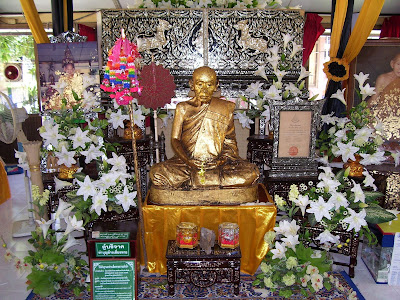
Inside the LP Daeng shrine, where we see his seated golden statue. Behind the altar is LP Daeng's casket. The driver told me LP Daeng's body was also undecaying like LP Tong of Wat Pagor, but I can't really tell since they did not use a glass casket like in LP Tong's case. After praying to LP Daeng, I approached the temple counter at the side to obtain some souvenirs. The amulets here are quite cheap & the helpers quite friendly. A Luang Pee (Venerable Brother) at the counter even gave me & the driver free amulets! This left me a good impression of the temple. With that, we made our way back to Hadyai.

Thursday, June 07, 2007

Travels in Pattani - Wat Changhai

On 21st May 2007 I travelled to Pattani province from Hadyai. As we know it is one of the hotbeds of terrorist attacks at this time. But I was determined to go pray at the temples devoted to LP Tuad, the most respected Bodhisattva monk in Thailand, despite the threat. One can feel the tension as along the way there were many road blocks & soldiers inspecting passing vehicles. My first stop was at the famous Wat Changhai, the place where LP Tuad entered Parinibbana. "Chang" means elephant & "hai" means given. That's why we see a lot of elephants at this temple. Above is the entrance & not far outside is the railway. You can read more about the legend of LP Tuad at: http://geocities.com/thai_pendants/legendary_lp_thuat.htm

Statues of an elephant & its mahout guarding the entrance. There were also many armed soldiers guarding the temple.
The temple's Wihan (Vihara).
This is the closeup view of the sacred LP Tuad golden statue inside the Wihan.
A more complete view of the statue & altar.
Other smaller statues at the side of the Wihan. Young girls are pasting gold leaf onto the statues.
Another slightly bigger LP Tuad statue in the Wihan, flanked by elephants.

This one is riding on an elephant.
Asked my driver to take this shot behind the Sala.

The altar inside the Sala. A reclining Buddha lies across it.
The Chedi-shaped shrine beside the railway.
Another golden statue of LP Tuad is venerated inside the shrine.
The main Chedi of Wat Changhai. Inside the chedi are the holy relics of LP Tuad. But it is closed to the public most of the time.
Inside the Bot. An ordination ceremony fro 6 guys was taking place at the time. When will I get my chance to ordain? Ajarn Tim, past abbot of Wat Changhai & the first master ever to make LP Tuad amulets. After getting some souvenirs from the temple counter, I proceeded to my next destination, Wat Saikow.

Saturday, June 02, 2007

Why do we prostrate?

Buddhists prostrate themselves everyday before the Triple Gems, whether it is to pray, to chant sutras, before they meditate etc. What is the purpose of such practice? Is is only for showing respect to holy people & objects, to venerate or even worship them? Or is there a deeper meaning to it?

The Noble Ones taught us that it is not the outward show of veneration that matters, but the conquest of ego & pride within your own mind that is really important. We do not prostrate ourselves out of fear or to beg for favours; we do it for the wisdom that arises from the weakening of attachment to a Self.

However, some people who studied the Mahayana teachings of emptiness come to the conclusion that most of the traditional Buddhist practices, including prostration, are meaningless outward rituals & should thus be abandoned. They fail to appreciate the teachings that these practices symbolize & how they benefit the mind. This is a mistake. One would think that the enlightened ones no longer need to follow such rituals, but the truth is not like that. There is a very interesting Koan to illustrate this point.

Once a young novice saw Huang Bo prostrating in front of a Buddha statue at a monastery. So he asked the master:
"Not to cling to the Buddha, not to cling to the Dharma, not to cling to the Sangha; may I know what is the master praying to?"
"Praying to such teachings of non-clinging" was the reply.
"So why are you still prostrating?" the novice pressed.
At this, Huang Bo gave the novice one tight slap!
Reeling from the pain, the novice exclaimed, "How can you be so rough?!"
"What place is this, such that you complain about roughness & fineness?"
The novice had an awakening at that moment.

Contemplate on "what place is this" & you may see the answer for yourself. Then you will automatically bow to the Triple Gems daily without anybody telling you to!

Monday, May 28, 2007

Visit to Wat Phra Mahathat


On 20th May 2007, after taking a tour around the temples in Pattalung, I asked my driver to take me all the way to Wat Phra Mahathat in Nakhon Si Thammarat, the famous birthplace of Jatukam Ramathep, a guardian deity that has taken Thailand by storm. All over Pattalung & even more so in NST, one can see Jatukam amulet ads virtually everywhere, from the roadside billboards, to banners, posters, shops, buildings, t-shirts. There is nowhere one can turn & NOT see Jatukam. This is indeed the height of the craze. When I arrived there in the afternoon, there was a consecration ceremony going on & the place was thronging with devotees, locals, visiting students, tourists & dealers.


Here we have children playing in the Buddha Footprint shrine of the temple.


The billboard advertising the batch of Jatukam amulets & buchas being consecrated on that day.

The statues of the 2 princes, Jatukam & Ramathep, the founders of this temple. Behind them is a replica of the ship containing the relics, which was capsized & drifted to this land. The marble board on the right tells of their legend.

A white chedi in the courtyard.

The entrance to the main shrine.

Walkway of minor chedis.

The focal point of the whole temple, the great Phra Boromathat Chedi housing the Buddha's relics.

The secondary chedi of the temple. Didn't know what it is called.

Inside the holy shrine of the main chedi. The flight of steps lead inside the chedi itself.

A closer look. The statues of Jatukam & Ramathep sit on the left & right of the chedi entrance, eternally guarding the relics of the Buddha. Its a bit dark inside the shrine and I apologise that my camera's flash isn't powerful enough.

Also guarding the entrance is this red skinned Tao Wessuwan.

A Phra Ruang statue opposite the entrance.

This red Naga King is another one of the guardians.

So is this blue Naga King.

Another view of the Phra Boromathat Chedi. All the minor chedis pay homage to the main one.

The outer perimeter of the main shrine, lined with Buddha statues and donation boxes.

The inner perimeter of the main shrine, lined with even bigger Buddha statues.

This marble board is inscribed with the Katha to pay homage to the relics in the Chedi. One is supposed to recite Namo tassa 3 times, followed by this Katha 3 times.

The Phra Ruang outside the temple's Bot.

Wax statues of the past abbots.

Another 2 wax statues of past abbots.

The Saisin (holy thread) web hanging above the altar of the Bot.

A great Bodhi tree in the courtyard. Locals rest on the benches below the tree. A farang teenager guided by a Thai girl have also came to tour the temple. Wonder if he could understand what is going on here or maybe even appreciate the powerful symbolism of the structures in this famous temple?

By right, having come all the way to this temple, I should get a Jatukam amulet or bucha back, but at this time anything associated with Jatukam is way too expensive. So the only souvenier I obtained is this more affordable brass bucha of Phra Buddha Sihing, the principal Buddha image of this province. I have placed it on my office altar for veneration. After getting this bucha, I proceeded on the long 2-hour journey back to Hadyai. Truly, the rise of Jatukam has brought immense wealth to this temple, as well as the whole populace of NST in recent years. But as all things are impermanent, what will happen to all these people who have put their livelihoods on the deity, once the craze subsides? Hmm..

Wednesday, May 02, 2007

Rebirth without a Soul

One question many newbies like to ask is: what is it that is reincarnated or reborn when Buddhists deny the existence of a soul. Why do Buddhists say there is no soul? Because a soul means there is a spirit in you that never changes. In the Buddhist understanding of rebirth, there is no such unchanging soul that goes from life to life. There is only a changing mind-stream that appears and disappears according to karma. Like an old candle that is used to light another new candle, can you say the flame of the first candle is the same as the second candle? It is obviously not the same flame, but the new flame owes its existence to the old one. The common qualities of all candle flames, like being hot, being bright, being able to burn things are inherited. We can neither say the new flame is same as the old one, nor can we say they are different. It is the same with the mind. The mind of this life owes its existence to the mind of the previous life. It inherits all the qualities of the previous mind, yet it has become a new mind altogether. Likewise, the mind that arises in another life is different from the mind of the previous life. Only a relationship of cause and effect links the new and old minds together, nothing more. So where can one find any soul?

Some people may also ask: if rebirth is real, why is it then I cannot remember my past lives, why is it that some people can? Past-life memories depends on how aware you are in your mind when you die, not on a soul that stores them. Those who die with clear awareness will be able to recall the cause and effect that link them to the previous existence when they are reborn. The quality of awareness appears and disappears along with the mind when you die and are reborn.

Let me give you another simile. It is like a mirror and its ability to reflect images. If you melt down an old mirror, its ability to reflect is also temporarily gone. But if you re-mold it into a new mirror, then the ability to reflect is there again. Depending on the conditions during re-molding, the clarity of reflection might be better, or might be worse than the previous mirror. In the same way, how far back one can remember will also depends on the conditions during rebirth. Because most of us are heavy with defilements, we can't even remember events that happened when we were babies, what more for events that took place in the previous life? However, if a person keeps polishing the dull mirror that is his mind, it will become clearer and clearer, such that it would be able to remember very very far back - 1 life, 2 lives, 10s, 100s, 1000s, millions of lives. And that is only one of the abilities of our mind-mirror. How does one polish this mirror? Through the practice of samatha-vipassana meditation as taught by the Noble Ones.

For example, ghosts tend to remember their previous life more than humans. Why is that so? Because of clinging. People who die with strong clinging to craving or anger are reborn as ghosts. This is almost like a state of deep concentration, but on wrong thoughts. Because of the very same quality, they cannot forget their previous life and although it makes them remember, it also brings them great suffering.

As for most beings reborn as humans, their clinging is light and their mind unfocused, so memories of good and bad fade through the process of rebirth, in the same way that we cannot remember past events if they are not very significant.

There are those experienced meditators, who by focusing their minds into Jhana at the point of death, are able to remember their previous lives after they are reborn as humans or devas. This is because their mind is clear and their awareness deep and powerful. As I mentioned previously, the level of awareness determines whether one can remember or not.

What about the enlightened ones, whose outflows are already cut off? For them, their minds are are constantly in Jhana, whether they are close to death or not. But although they attain the Jhanas, they do not abide in these states like the worldly meditators. That's why they are no longer reborn in the heaven realms or anywhere else. That which is non-abiding is the deathless quality, the realm of Nibbana. When you can find this quality within your own mind, then "birth is ended, death is ended, the holy life is fulfilled and there is nothing left to be done."

Acala Vidyaraja (不动明王)

Who is Acala? Acala or the Immovable One is the Chief of all Guardian Deities in Buddhism. He is actually a manifestation of Maha Vairocana, the Universal Buddha, in the form of a wrathful servant who protects all Buddhas. In his hands he holds a flaming sword which represents the wisdom that is able to cut through all defilements, as well as a rope which represents the skillful means to snare all wayward sentient beings to the Dharma. His halo of flames represent the power of his Samadhi, which although unmoving, can appear anywhere in the universe. Thus he is called the Immovable. It also refers to the Buddha-nature in all of us. I've a fond liking of Acala since young, when I first came across this deity in the Japanese manga, "The Peacock King". I thought he was a pretty cool guardian deity, sort of like an enlightened warrior servant.

The Mantras of Acala 不动明王 are 4 in number.
真言有殘食咒、火界咒、慈救咒、一字心真言等之別,其中,

Mantra of Ferocious Eating 殘食咒為:

曩莫三曼多縛日羅赧
(namah samanta vajranam,歸命普遍諸金剛)
怛羅吒(trat,殘害破障)
阿謨伽戰拏(amogha canda,不空暴惡)
摩賀路灑儜(maha rosana ,大忿怒)
娑頗吒野(sphataya,破壞)
吽(hum,恐怖)怛羅麼野(tramaya,堅固)
吽(hum)怛羅吒 (trat) 唅(ham mam,種子),
此出自底哩三昧耶不動尊聖者念誦秘密法卷中。

Mantra of the Fire Realm 火界咒為:

曩莫薩縛怛他孽帝毗藥
(namah sarva tathagatebhyah,歸命一切如來)
薩縛目契毗藥(sarva mukhebhyah,一切諸面門)
薩縛他(sarvatha,一切處) 咀羅吒(trat,叱呵破障)
贊拏(canda,暴惡)
摩訶路灑拏(maha rosana,大忿怒)
欠(kham) 佉呬佉呬(khahi khahi
薩縛尾覲南(sarva vighanam,一切障礙)
吽(hum,摧破)怛羅吒(trat
憾(ham mam,種子),
乃出自金剛手光明灌頂經最勝立印聖無動尊大威怒王念誦儀軌法品。

Mantra of Compassionate Rescue 慈救咒為:

曩莫三曼多縛日羅赧
(namah samanta vajranam,歸命普遍諸金剛)
戰拏摩訶路灑拏(canda maha rosana,暴惡大忿怒)
薩頗吒也(sphataya,破壞)吽(hum,恐怖)
怛羅迦 ( traka,堅固)
悍漫(ham mam,種子)

The Heart Mantra 一字心真言為:

‘南麼三曼多伐折羅赧悍’,
(namah samanta vajranam ham 歸命普遍諸金剛種子)
此二者均出自大日經卷二普通真言藏品。

These mantras represent the various qualities of Acala. The Mantra of Ferocious Eating invokes his power to eat away all our karmic obstacles. The Mantra of the Fire Realm is able to burn away all our defilements. The Mantra of Compassionate Rescue represents his ability to protect all sentient beings, and the Heart Mantra brings out the immovable aspect in our Buddha-nature. Acala's sadhana (method) belongs to the carya tantra of the Vajrayana tradition and it is a powerful one. If a person of the right aptitude is initiated into this sadhana, constant practice will quickly lead one to enlightenment.