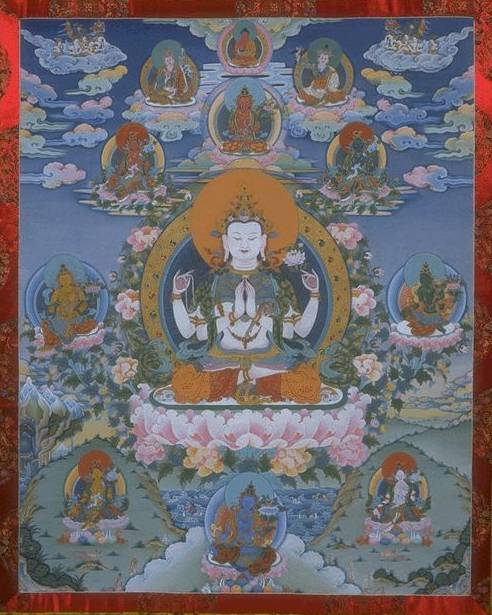
 A Bodhisattva, relying on this Prajna Paramita, is free from all hindrances as they too, are empty.
1. The Prajna Paramita that can be relied on is not the real Prajna Paramita. If a Bodhisattva needs to rely on anything at all, then we should kick him out of the window! We ourselves are Prajna Paramita; complete with all Dharmas, lacking in nothing. Why speak as if it is something outside for us to depend on? If we think that there is something to rely on, then we will forever be seeking external objects & be blind to our own Buddha-nature. This is the path of Samsara.
Ven Linji once went to visit Bodhidharma's tomb. The keeper asked him:
"Does the Ven wish to pray to the Buddha first, or to the Patriach (Bodhidharma)?"
Linji: "I will neither pray to the Buddha, nor to the Patriach."
Keeper: "What grievances to you have with the Buddha & the Patriach?"
At this point, Linji laughed, shook down his sleeves and left, leaving the keeper in puzzlement.
The Buddha & the Patriach both taught us to look within our own minds for the Truth; how could Linji do otherwise?
2. The hindrances generally refer to (a) sensual desire, (b) ill-will, (c) sloth & torpor, (d) restlessness & remorse, (e) sceptical doubt. They hinder one from seeing the true nature of the mind, for they are manifestations of Avijja. But if a person can in an instant, realize directly that there is no mind, then what can these hindrances hinder? That's why the 6th Patriach said that:
"Bodhi has no tree,
The Bright Mirror is not a stand;
Intrinsically there is nothing,
Where can dust alight?"
If one has a mind, one is sure to have mental dust; when one has mental dust, one is sure to have 84,000 kinds of kleshas. One may sweep off the dust now & then, but after a while new dust gathers once more. This is just another a never-ending cycle which is not in line with the Dharma. Like trying to cut a fountain of water with a sword, you will never succeed as new water constantly flows out from the source. Why not go directly to the source? That is the only way to go!
Free from all fear and apart from inverted views, he reaches Final Nirvana.
1. This fear refers to the fear of birth & death, the fear of suffering. When one realizes all encompassing emptiness, birth & death becomes non-dual with cessation. Whether one comes or goes, the Buddha-nature remains unmoved. Like an illusionary man created by an illusionist, the illusionist feels no fear at all with the arising & dissappearing of the illusion. This is because he knows that the man is intrinsically unreal.
2. Inverted views refer to the 62 wrong views, consisting of the 5 aggregates considered under the 3 eras of past, present & future. In the past, each aggregate may be permanant, impermanant, both & neither (5 x 4). In the present, each aggregate may be finite, infinite, both or neither (5 x 4). In the future, each aggregate may continue, discontinue, both or neither (5 x 4). That adds up to 60. Plus the 2 views that the body & mind is either united or separate, we have the 62 wrong views. However after one sees the Buddha-nature, the 5 aggregates return to emptiness, as well as all concepts of time & space. Thus all the 62 wrong views can no longer be established.
3. Final Nirvana refers to Parinirvana or Nirvana without remainder. Contrary to what most people understand, Parinirvana does not refer to the manifestation of death of the enlightened ones, but the Unborn & Undying virtue of the Buddha-nature. Thus the Vimalakirti sutra says:
"All Dharmas fundamentally do not arise,
And thus they also do not enter into cessation;
That is the meaning of Nirvana."
The Parinirvana Sutra says:
"The teaching of Impermanance,
Still falls under the realm of duality;
Only when duality is no more,
Can one realize the bliss of Nirvana."
As such, all duality, birth & death & the 5 aggregates are absorbed back into the Absolute & simply become means for the Dharma to reveal itself to sentient beings. That is why the enlightened being lives in complete freedom, doing anything he wishes, preaching only when the opportunity arises & passing away in any manner & at any time he chooses. Like a jester, the Bodhisattva displays various activities among the world as if they are games, but in these games contain the direction that leads beings to the highest truth.
In the past Ven Long Tan went to study Zen with Ven Tian Huang. After staying for a long time, Long Tan asked Tian Huang:
"Master, after coming here, I've yet to receive any instruction from you."
Huang: "Since you came here, I've never neglected instructing you in the essence of the mind before."
Tan: "Where have you given me any instructions?"
Huang: "When you bring me a cup of tea, I drink it. When you bring me my meals, I eat them. When you salute me, I nod my head. Where have I not given you instructions?"
Tan lowered his head to think about what his master said. At this point Huang shouted:
"To see the Truth, you must see it right now! If you try to think then it is already gone!"
Tan attained enlightenment upon hearing these words.
Thus you see that there is not a single moment that the Bodhisattva does not teach the Dharma, but sentient beings simply could not catch the hint!
All Buddhas of the 3 eras (past, present and future) also rely on Prajna Paramita to attain anuttara-samya-ksambodhi (complete enlightenment).
1. What are the Buddhas of the 3 eras? The past thought does not arise is the past Buddha. The present thought does not stay is the present Buddha. The future thought does not cease is the future Buddha. The Diamond Sutra says:
"The past mind cannot be found,
The present mind cannot be found;
The future mind also cannot be found."
That which neither arises, abides nor ceases is the true Buddha - your own Buddha-nature.
2. The Buddhas do not rely on Prajna Paramita. Why? They themselves are Prajna, they themselves are Paramita! If they still need to rely on anything at all, then they cannot be called Buddhas.
In the Manjusri Prajna Paramita Sutra, the Buddha asked Manjusri:
"Have you gained all-prevading wisdom?"
Manjusri: "I myself am this all-pervading wisdom. Why would I need to seek it anywhere else?"
This sutra is full of traps. If you are not sharp enough, you will fall right into them and cannot escape.
3. There's no Dharma called anuttara-samya-ksambodhi or complete enlightenment. What more for its attainment? All there exist are names without any real meaning at all. The Buddha said:
"If I have gained any Dharma at all from Dipankara Buddha, then Dipankara Buddha would never have given me his prophecy (of future Buddhahood)."
Nothing gained, nothing attained, nothing lost, nothing denied. That is the true meaning of complete enlightenment.
Therefore know that Prajna Paramita is the great divine mantra,
1. Mantra are syllables & words of Truth that contain immense power, able to alter the conventional laws of reality when spoken by the right person. The Nobles Ones, sometimes even ordinary people, were able to perform what we perceive as miracles by reciting certain words of Truth. However, in this case, Mantra refer to all the inconceivable Dharma that issue forth from our Buddha-nature. This Mantra is wordless, formless, featureless and One with the Absolute. The sutras say:
"Only the Enlightened & other Enlightened Ones can know it."
2. Great divine mantra refers to the supernormal powers of the Buddha-nature. Traditionally, there are 6 supernormal powers. But these powers have a different meaning when discerned by Prajna Paramita. Ven Huihai once said:
"The Divine & Complete Buddha-nature,
Is omnipresent in all the infinite world systems;
Be there mountains, rivers, rocks or walls,
It comes & goes without obstruction."
i) Divine eye - all that one sees is the unborn & undying nature of the mind. The scriptures say:
"See that the mind is without appearance, see that the Buddha is no different."
ii) Divine ear - all that one hears is the Dharma of the Absolute. The scriptures say:
"The grass, the birds & the forests; all of them can recite the Dharma."
iii) Knowledge of the minds of others - knowing that all the minds of sentient beings are no different from the minds of the Buddhas. Upon his enlightenment, the Buddha exclaimed:
"Wonder of wonders! All sentient beings possess the wisdom-virtue of the Tathagata, yet they cannot see it due to their own kleshas!"
iv) Transformation at will - the complete freedom of the Buddha-nature to reveal itself through any worldly or non-wordly means. The scriptures say:
"Every plant & tree, every grain of sand & stone;
Not a single object here is apart from the Bodhisattva's manifestations."
v) Knowledge of past lives & future destiny - knowing that all the Buddhas & Patriaches of the past, present & future have & will continue to walk the same path, understand the same Truth & preach the same doctrine; for there is no Dharma other than the Mind. The scriptures say:
"All the Buddhas of the 3 eras, share the same Dharmakaya."
vi) Freedom without remainder from the wheel of Samsara - understanding without a doubt that the Mind is Samsara, the Mind is Nirvana, the Mind neither comes nor goes, increases of decreases. No less than the dissolving of all duality & complete realization of emptiness. The Dhammapada says:
"Dwelling in the cave (of the heart),
The mind, without form, wanders far and alone.
Those who subdue this mind,
Are liberated from the bonds of Mara."
These are the 6 supernormal powers of the Buddha-nature, the great divine mantra.
the great bright mantra, the supreme mantra, the incomparable mantra.
1. Bright in this verse refers to the brightness of 3 Vijja or super knowledges. What are these 3? They are actually part of the 6 supernormal powers explained earlier, namely:
i) Divine Eye
ii) Knowledge of past lives & future destiny
iii) Freedom without remainder from Samsara
The difference between the power & the knowledge is that the latter is far more penetrative than the former, because is no longer hindered by coarse or even subtle kleshas, thereby regaining its full clarity. Worldly yogis, rishis & devas may also have supernormal powers, but only the enlightened ones possess the 3 super knowledges. In the case of Prajna Paramita, however, there is no such difference. The powers & knowledges of the Buddha-nature are completely One.
Once there was a Rishi who have attained the 5 supernormal powers asking the Buddha: "World-honoured One, you possess the 6 supernormal powers, whereas I only have 5 powers. What is the 6th power?"
The Buddha suddenly exclaimed: "Rishi!"
The Rishi answered: "Yes, lord?"
Buddha: "That power; why do you ask me?"
The 6th Power, the 3rd Knowledge, Prajna Paramita, all refer to the same thing. Do you know what is it?
2. Supreme refers to the omnipresent quality of Prajna Paramita. There is nothing above it or outside of it. Like the Avatamsaka Sutra said:
"Such as the True Thusness, which is present in all places.
Transference of good roots is likewise,
In a single thought moment, it reaches all world systems."
Because the nature of the mind is such, it can reach places like the Pure Land of Amitabha in a single instant, even though it is "10 billion world systems" away from our Saha world. If the mind was not so, then all our practices would have been in vain. Thus, you can see that space & distance are merely illusions.
3. Incomparable refers to the quality of omniscience. Because all Buddhas & sentient beings share the same Buddha-nature, they also share the same infinite wisdom. In terms of the Absolute, the mind, the Buddhas & sentient beings are One. Why is this so? Because in the Absoulte there is no Mind, no Buddhas & no sentient beings. Thus the scriptures say:
"Prajna in Unknowing,
Yet there is nothing it does not know.
Prajna is Unseeing,
Yet there is nothing it does not see."
Profound indeed is Prajna Paramita. There is nothing comparable to it in the entire Dharmadhatu. If you can see directly into where there is no mind, then this whole universe will become your playground.
Able to remove all suffering, because it is one with reality & free from all falsehood.
1. It removes all suffering because it shatters false clinging to a sufferer. When there is no sufferer, where can you find suffering?
Once Ven Baizhang & Ven Mazu were strolling together in an open field. Suddenly a bunch of wild geese flew by overhead. Mazu asked Baizhang:
"What are those?"
Baizhang: "Wild geese."
Mazu: "Where are they now?"
Baizhang: "Flew away."
Suddenly, Mazu pinched Baizhang's nose as hard as he possibly could. Baizhang screamed in pain!
Mazu: "Clearly still around! Since when did it flew away?"
Baizhang was immediately awakened after hearing these words.
Baizhang realized at that point that which does not suffer. Can you also see it?
2. What does it mean by being real & free from falsehood? Ven Xuanjue said:
"The freed cultivator who ceases all learning & becomes non-active,
Does not remove false thought nor does he seek reality.
The nature of fundamental ignorance is the Buddha-nature,
The illusionary & empty body is the Dharma body (Dharmakaya)."
All falsehood becomes reality in the absence of discrimination. Why? Because both falsehood & reality is not apart from emptiness. As such, there is neither falsehood nor reality - that is the true reality! Besides this true reality, I still have one more piece of Dharma to share with you. What is it? The tree behind my house is almost 90 feet tall.
To recite the Prajna-paramita mantra, say it thus:
"Ga-te, ga-te, para-ga-te, para-sam-ga-te, bodhi svaha."
Ah yes, the final part of the Heart Sutra, to recite that which is beyond words. Ga-te is a Sanskrit word meaning "Gone". Gone where? Gone to where there is neither coming nor going, where there is no birth & death, no entanglement & no liberation. Para-gate means "Gone beyond" & Para-sam-gate means "Totally gone beyond". Bodhi means enlightenment, svaha means to acheive. The whole verse of mantra means "To achieve enlightenment when you have totally gone beyond". The key word here is Ga-te. All the rest are merely emphasis words for the word Ga-te. If people ask you whether there is a single word that contains the essense of the whoe Heart Sutra, say there is none. But if they are still not satisfied, tell them it is the word Ga-te. If they ask for instruction on how to practice, tell them to meditate on the meaning of Ga-te. This is the final skillful means taught by the Heart Sutra. Remember it well!
With that, we have come to the end of this commentary. Although not a single word has been said, may it still be beneficial to all beings who bother to read it. May the blessings of all Buddhas be unto you all.

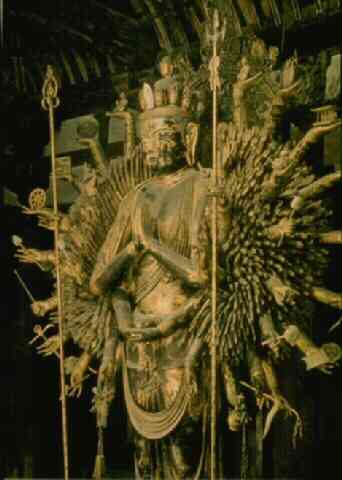

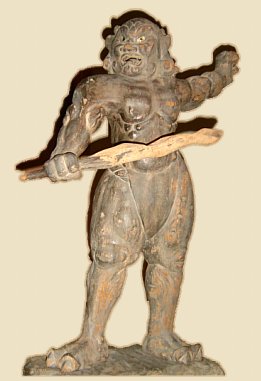

 All Wudi had created with his good deeds was only worldy merit, for he had performed them with a deluded mind. Worldy merit, was according to Bodhidharma: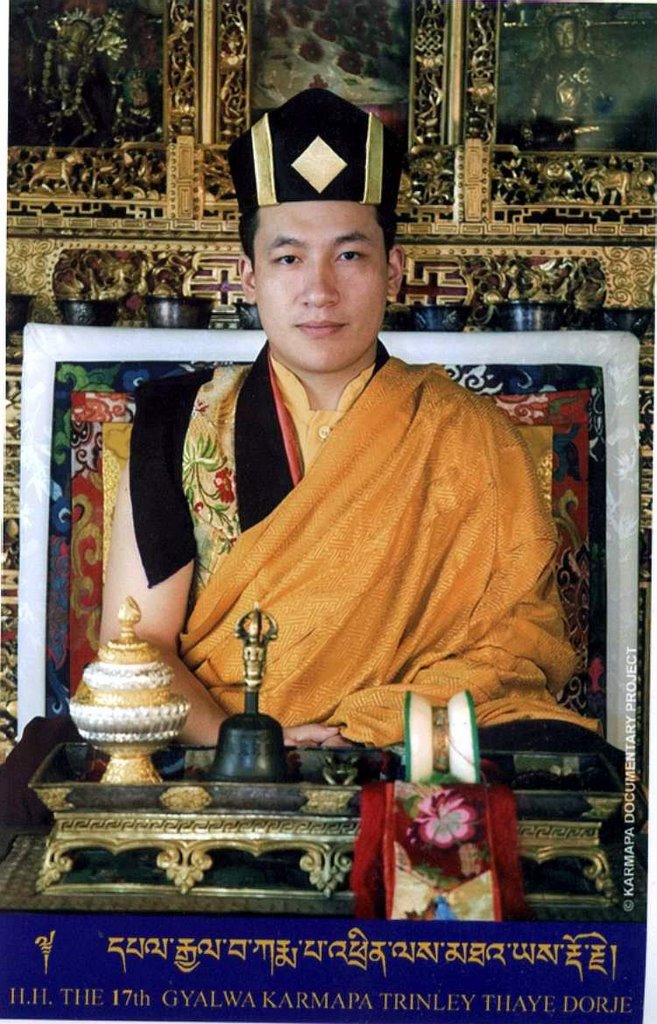
 Here we see the Karmapa arriving at the Karma Kagyud Buddhist Centre in Singapore, being welcomed by many local & foreign devotees. It is a rare opportunity to meet the Karmapa, who has been reincarnated so many times to help sentient beings. On this occasion (8-10-2006) he conducted the taking of the 3 Refuges as well as the Bodhisattva vow ceremonies. After a discourse on the meaning of the refuges & the why we must arouse our Bodhicitta (the resolution to seek Buddhahood) in fluent English, he began the Tibetan chanting, leading the devotees to repeat after him.
 When the chanting is over, all the devotees started to queue up in a typical Singaporean fashion to be blessed by the Karmapa. Each of the devotees, local & foreign alike have a little of their hair cut to symbolize the abandonment of defilements & doubt in the Triple Gems.
 Here we see the Karmapa sitting upon his throne to touch the head of every devotee as a way of blessing. It was tiring for him due to the large numbers of devotees, but the unwavering compassion for all beings is what drives this Bodhisattva on. I also witnessed that one lady brought her dog into the hall to be blessed by the Karmapa as well! But he did not turn her down because it was an animal, which shows his equanimity for all sentient beings is genuine.
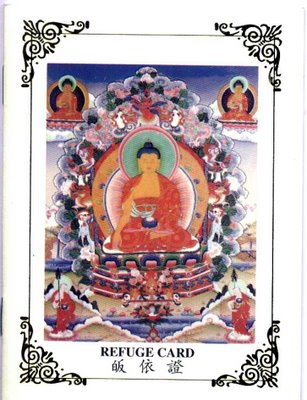 This is the new refuge card given to those who have taken refuge on this day. Although I have taken them before 9 years ago under this school, I decided to have them renewed again since the Karmapa is here in Singapore. So my Dharma name has been changed from Migyur Dorje (Unchangable Vajra) to Konchog Tendar (Flourishing Dharma). A joyous occasion it was! Over the next few days the Karmapa will conduct various initiation & empowerment ceremonies for deities like Red Chenrezig, Medicine Buddha & Amitayus Buddha. May all beings who have the good karma to be present, who accept & practice his teachings attain Enlightenment in one lifetime, sadhu.
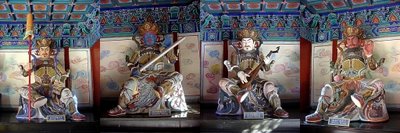 Real life is sometimes stranger than fiction. The moral of this story is to respect the land we live on, & also not to dismiss things we cannot see with our naked eye. Thus there is such a verse in the Atanatiya Paritta given by the 4 Heavenly Kings (recited for protection against evil spirits):
 The odd looking Jow Ngaw เจ้าเงาะ is worshipped as a deity of prosperity by some Thais. Jow Ngaw originally refered to a character in a literature by King Rama II - SangThong สังข์ทอง, the original work is in poem form but there are simplified versions for children and an animation was also made.
 The story is based around a prince named SangThong. His mom was a wife of a King but when she gave birth to the baby, it came out as a conch shell so she (and her conch shell) had been expelled from the palace. She went to stayed with an old couple where she supposed to do the housework, but the place always mysteriously clean itself. One day she found out that there was a boy came out from the conch shell and do all the housework. This boy is SangThong.
 Why do Thai people worship Jow Ngaw instead of SangThong? Because when SangThong grew up, he wore Jao Ngaw costume all the time so when you say SangThong, Thai people have an image of the baby with the conch shell which was very small part of the story. For the most of the story, things happened when he was Jao Ngaw. Moreover, the most famous part of the story is where Rojana chose her groom. This part is often taken out to make a traditional Khon play, which was when he was Jao Ngaw, as seen on photo of traditional play above (Jow Ngaw is the one at the back obviously). So although Jow Ngaw is a fictional character, it is so deeply imprinted in the Thai people's minds that it eventually becomes an actual deity. This is no different from how some Chinese worship Sun Wukong, the Monkey God from the classic - "Journey to the West".
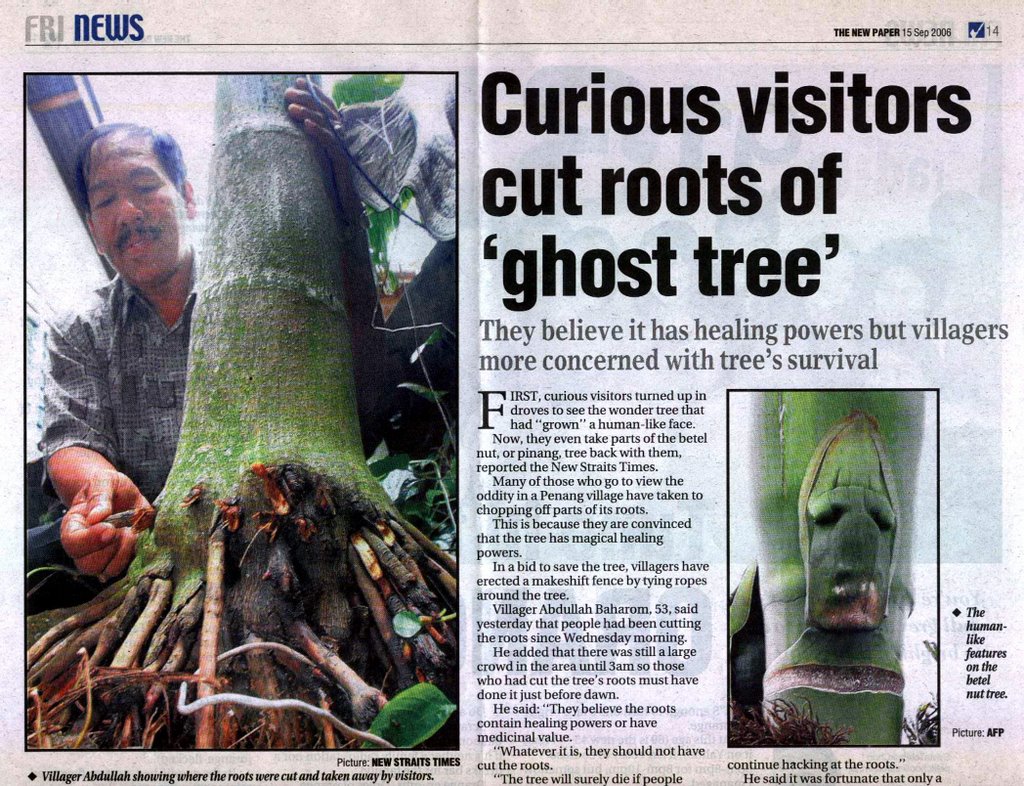
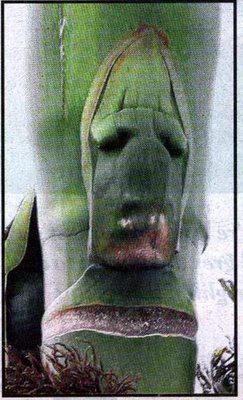 Look at how human-like the face is! Some say the face changes everyday, but it sure looks damn unhappy here. Maybe its those dumb people who are cutting the roots pissing it off. That's why they call it a "ghost tree". Chinese visitors also started to offer joss sticks & flowers to this ghost tree, praying for 4-D numbers. Some of the smart villagers also sell photos of the face to visitors for 2 ringgit each. I think they might as well get a bomoh to make amulets out of its betel nuts. Why hasn't anybody thought of it yet? This also reminds me of the tree shrine in Choa Chu Kang where they found a Lukkok. I wonder which Ajahn wannabe buried it there, of all places. When there's so many people praying there, someone is sure to discover his "baby"! Well now that its with the police, some people have put up a separate shrine there to make offerings to the baby spirit. Wierd stuff..
 A wake was immediately set up at the Maha Vihara Temple in KL, where the Ven was the abbot. Devotees from all over Malaysia & Singapore flooded in to pay their last respects to this great teacher.
 On 3rd Sep 2006, his body was transported to the Nirvana Memorial Park in Semenyih to be cremated on a hilltop. The Sri Lankan Prime Minister Mr Ratnasiri Wickremanayake specially flew in to join the thousands of mourners who came to witness the cremation ceremony.
 On the way to the memorial park, raindrops which resembled snowflakes started to fall, a sign that even the Devas mourned the passing away of this Maha Thera. The above photo was snapped by one of the mourners and published in Malaysia's New Life Post paper.
  During the cremation in the evening (around 6.15pm), more miraculous signs started to appear. Devotees heard claps of thunder, after which they saw in the northern sky images of a great Stupa, as well as celestial Nagas protecting it. Some say this is a sign that the Heavenly King Vessamana, guardian of the North & often portrayed as carrying a Stupa, had came to receive the Ven's relics. The following morning, when the chanting ceremony started around 9 something am, everyone present saw a white light shining forth from the sky above the 3 storey high funeral pyre containing the Ven's remains. Within the light there appeared 2 clouds, one resembling Ven Dhammananda in a samatid posture (see above photo) and the other resembling a Bodhisattva (some say Guanyin) who has also came to receive him. This vision lasted for 5 mins and dissappeared when the chanting was over. Although the monks present told the devotees there not to take these signs too seriously and that they might just be natural phenomena, but everyone who saw them can't help but be filled with deep awe and renewed faith in the Dhamma. To see more photos, go to
  These miraculous signs indicate that Ven Dhammananda is by no means an ordinary monk, but an Ariya who has attained one of the fruits of Sainthood. The Diamond Sutra says: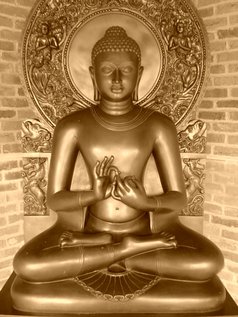



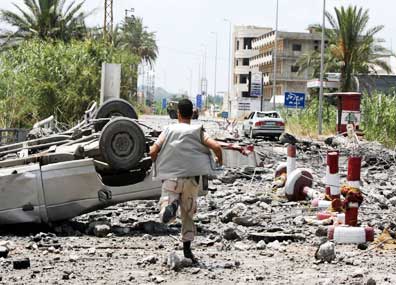 By now, all of us have seen the Israel-Lebanon conflict in the news. War is cruel & innocent people are dying. Scenes of the dead resemble that of the torments suffered in Hell. Where does all this suffering come from?