Saturday, February 24, 2007

Year of the Pig 2007

The Classic of History say:

"When Heaven creates calamity,
There is still hope to be forgiven;
But if you yourself create calamity,
There is no hope of escape."

The Year of the Pig has arrived once again. This year belong to the heavenly stem & earthly branch of Ding Hai. Contrary to popular belief, this year is not the Golden Pig, but belongs to the Fire Pig, because the heavenly stem of Ding in under the element of Fire. According to the Tongsheng (Traditional Chinese Almanac) forecast, this year will be one of abundance in crop harvest. The Earth Mother Scripture says:

"Sowing in Summer one encounters thirst in Autumn,
The harvest in Autumn comes to 80 percent;
Plagues will be rampant among the people,
And the livestock will face great difficulty;
The joy of the silk women would be in vain,
For although the silkworms are many,
Yet they do not form cocoons."

So although agricultural nations can expect a good harvest, they will encounter drought in autumn. And for silk farmers, they will not be able to get much silk this year since the silkworms will be many yet unproductive.

One important thing to note is the mention of plagues among men & animals. Coincidentally, the annual Flying Stars movement chart also foretell of such problems. This year the 2 Black Star have taken central placing, whereas the 5 Yellow Star have shifted to the Northeast. These are the unlucky stars that bring trouble for Man. 2 Black is the Star of Pestilence & 5 Yellow is the Star of Plague or Calamity. Thus we might expect a virus outbreak in the central & northeast regions of the world. The "world" can mean China, Asia, or perhaps even the globe. Bird Flu is a likely candidate since it continues to plague many regions in Asia, but new viruses mutations are also possible. We should also not forget the year 2003, where the 5 Yellow Star was in the Southeast, corresponding to the SARS outbreak in Southeast China (Guangdong province) & Southeast Asia (Singapore). Will history repeat itself this year? The wise knows that precautions need to be taken no matter how things turn out.

Whenever plagues bring calamity to Man, the root cause can always be traced back to his negative karma of killing. In the case of SARS, it was the indiscriminate killing of civet cats & other wild animals in Guangdong that led to the birth of that terrible virus. In the case of Bird Flu, it was the inhumane killing of fowl that caused it to spread to human beings. Once every few years, the collective karma of all these killing will reach a boiling point, erupting into a new virus outbreak against Man. In reality the stars do not give us disaster, but we give ourselves disaster. The unlucky stars are merely a reflection of the bad karma we create by not observing the 5 percepts of refraining from killing, theft, sexual misconduct, false speech & intoxicants. But history reveals that often it is the sin of killing that bears negative fruits in the swiftest time.

Therefore if we really want to avoid suffering, we must stop taking lives & cultivate compassion towards all sentient beings. Although vegetarianism is optional in Buddhism, even though we need not give up eating meat in our Dhamma practice, we must always observe the 4 rules of pure consumption, namely:

1. Not to eat if one sees the animal being killed.

2. Not to eat if one hears the animal being killed.

3. Not to eat if the animal is killed specially for you.

4. Not to eat if the animal is reared by yourself.

If we can observe these 4 rules, then we would not create negative karma in our daily dietary needs. If we can be vegetarian, that is even better; but depending on physical conditions, not everyone can adjust to a completely vegetarian diet. That is why the Buddha recommended flexiblity on this point. The most important teaching to remember is to have compassion for animals in the same way as humans. Do not do unto them what we would not do unto ourselves. To refrain from killing as well as to observe the rest of the 5 percepts is the true path to happiness. If we observe the percepts as though our lives depended on them, then no plagues or calamities can ever befall us, sadhu.

Tuesday, February 20, 2007

The Original Face

What is the Original Face? It is the face all of us have before our parents gave birth to us. Before we even have the 6 sense organs of eyes, ears, nose, tounge, body & brain to perceive the 6 sense objects of form, sound, smell, taste, feeling & thought. Before we even know good & evil, happiness & suffering, samsara & nirvana. Simply the pure awareness untainted by all 6 senses - that is the real YOU. That is also me, that is also all sentient beings & all Buddhas. This is the Dharma that the 6th Patriarch revealed to his pursuer Hui Ming on Da Yu mountain. By temporarily shutting down your 6 sense organs and blocking out the 6 sense objects, by abandoning duality, what is left at that instant is your true nature. Like the still lake without a single ripple, or like the clear blue sky without a single cloud; the original face is vast, limitless, formless & completely free. It is not dull nothingness like an unconscious person, but a living, unmoving awareness that pervades all things, yet remaining unaffected by all things. Besides this, there is no other esoteric teachings that the Buddha & the Patriarches can impart to us.
But alas, for all of us, after we have picked up a physical body in our mother's womb, we have totally forgotten our original face. We started to grasp on to our sense organs, believing that to be our Self, our Ego. This is where the ignorance without a beginning - Avijja takes over. When our sense organs contact the sense objects, we instinctively allow the objects to enslave the organs, such that craving & aversion developes without an end, engulfing the entire universe. From Avijja arises craving & aversion, & from craving & aversion arises endless suffering.
Thus realizing this, the Zen practitioner should, in a single thought understand his or her own mistake, & immediately detach oneself from one's senses & its objects from within. Throwing away all concepts, directly penetrate the veil of Avijja & recover your original face. This is the common hope of all Buddhas & Patriarches for all sentient beings. Let none of us dissappoint them, sadhu.

Sunday, February 18, 2007

Is Pure Land more practical than Zen?

There are some Pure Land teachers who claim that in this Dharma Ending Age, you can only hope to acheive result through Amitabha recitation. They believe that seeking rebirth in the Pure Land is the only reliable way of transcending Samsara. All the other Mahayana schools, especially Zen, only works for the ancients, who have greater aptitude & determination than any modern person. They say there are almost no enlightened Zen masters left in the world today, whereas there are still thousands of Pure Land practitioners who have achieved rebirth there. So this is a proven method with live examples that we should all follow. What are we to make of this kind of rhetoric?
Chan Master Ven Xuyun had this to say:

"For those who have attained enlightenment, all Dharmas are universally penetrating. Zen contemplation is the Way, Buddha recitation is the Way, even mundane chores like digging the soil is the Way. In my whole life I have never discouraged anybody from recitation, but I'm not happy with those people who discourage others from contemplation."

There are 84,000 methods that lead to enlightenment; no one path is superior to another. Zen is Zen & Pure Land is Pure Land, what good does it do to put down one in order to elevate the other? Saying that the ancients are superior to modern men is self-defeating talk. Although people of the present have much more distractions then those of the past, but in terms of intelligence, didn't modern men built airplanes, bullet trains, satellites, super computers, sky-scrapers & spaceships that could land on the moon? If we talk about the kleshas, the mental defilements that affect sentient beings are the same for all men, no matter whether they lived in the past, present or future. Just go through the Sutta Pitaka & you will realize that some of the Buddha's followers have even worse obstacles than we do, but that did not stop them from eventually reaching enlightenment in one lifetime. So why should we look down on ourselves & give up before we have even made a good effort?

As for saying that there are no more enlightened Zen masters left in the world; who then is Ven Xuyun? Who is Ven Yuexi? Are they Pacceka (Solitary) Buddhas who attain enlightenment on their own? Surely not. They too learned from other enlightened masters in their younger days. The fact is that the Chan lineage in China was never broken. The heart transmission of Zen carries on, generation after generation from the 6th Patriarch up to this day. The same could be said for the Zen lineages in Korea, Japan & elsewhere. Those who say that there are no more people who achieved result from Zen contemplation are surely misguided or misinformed.

Regarding the claim that many practitioners who practiced Amitabha recitation achieved rebirth in the Pure Land, with auspicious signs to prove, I believe that there is nothing wrong with that. These serve as inspirations for those inclined to practice the Pure Land teachings. However, at no point should anybody make use of these stories to put down other schools & propogate Pure Land as the only method that works! The scriptures say:

"Virtuous One, concepts of superiority & inferiority exist in your own mind. They are not in accordance with the Buddha's wisdom."

A truly wise teacher will not only encourage people to practice the method of his own school, but at the same time he should also praise the merits of the other schools without any discrimination. Only in this way the teacher can be in accordance with the Buddha's wisdom & ensure the long-term harmony of His Sasana, sadhu. Happy Chinese New Year 2007 to all!

Thursday, February 08, 2007

Huang Bo's instruction to the dying man

Ven Huangbo Xiyun (776 - 856 CE), a native of Fuzhou in Fujian province, is one of the great Chan masters of the Tang Dynasty. He is also the teacher of Ven Linji Yixuan, founder of the Linji (Rinzai) school of Chan Buddhism. His teachings, recorded in 2 books, "The Dharma Essence of Chan Master Huangbo's Heart Tranmission" & "Wanling Records of Chan Master Huangbo", have a far-reaching influence on Chan or Zen practitioners up to this day.

Huangbo had this to say for instructions to a dying person:

"If an ordinary man, when he is about to die, could only see that -
The 5 aggregates & the 4 elements as void and not Self;
The True Mind as formless and neither coming nor going;
His nature as something neither beginning at his birth nor ceasing at his death, but as perfect and unmoving in its very core;
His mind and its projections as One --
If he could thus enter straight into sudden enlightenment, he would no longer be entangled by the 3 Realms and become a World Transcender.
One should not even have the faintest tendency towards rebirth.
If you should behold the glorious vision of all the Buddhas coming to receive you, surrounded by every kind of auspicious manifestations, you should feel no desire to follow them.
If you should behold all sorts of horrific forms surrounding you, you should also experience no fear. Simply forget your own mind and become one with the Dharmakaya, gaining absolute freedom.
This is the essential principle."

How should we understand this? It means that a person, whether living or dying, must come to the realization that our entire physical & mental world is totally illusionary. The true mind is like a movie screen. The elements, aggregates, sense organs, its objects, & our consciousness; all these are movie images projected onto the screen. These moving images tells all sorts of stories, some happy, others sad, some long, some short, but all coming to an end at some point of time. But the screen? It simply remains as a screen no matter how many movies have been projected onto it. Since time immemorial, this screen has always remained the same for all Buddhas & sentient beings alike. However, due to the obstruction of Avijja, sentient beings never see the screen itself, only the movies on the screen. They believe these ever-moving series of images to be their self, their life, their only reality. Death is like the short intermission between one movie & the next. At this point where all images dissolve temporarily, it is the easiest to see the movie screen, provided one possesses the Right View.

Therefore the Chan practitioner must cultivate Right View & let it be permanantly carved into one's mind. Even if you do not reach enlightenment in this life, it will surely guide you to enlightenment when you recall it at the moment of death.

Monday, January 29, 2007

The Legend of Phra Sai & Ong Tue

I just returned from a trip to Udon Thani around a week ago. While I was there I went to the various famous & not so famous temples in Udon, as well as Nong Khai. In Nong Khai there are 2 important temples, Wat Pho Chai & Wat Si Chompu Ong Tue. They house the 2 principal Buddha images of the province, LP Phra Sai (灵感佛) & LP Phra Chao Ong Tue respectively.
Wat Pho Chai is located just outside the Nong Khai town. The gold image of LP Phra Sai is in the posture of subduing Mara. The lap width is 28 inches while the height is 41 inches. This sacred Buddha image has been enshrined since the establishment of the province. The history of this image relates to many parts of Thai history but it is unclear when it was cast or who cast it. Prince Damrong Rachanuphap speculated on its origin in a book called "Histories of Important Buddha Statues", which was published and distributed in a royal kathina ceremony in the year 1925. Prince Damrong thought that LP Phra Sai was cast in the Lan Chang Kingdom in Laos. According to legend, 3 princesses were the people who caused the images to be casted. Another legend gives us more details. It goes like this:
King Chaiyachetthathirat's had 3 daughters named Serm, Suk, and Sai. They had the unanimous wish of casting their own personal Buddha images. They then asked their father for support, thus leading to the king's command to cost three Buddha images having different sizes according to their ages, the oldest having the largest image. They were named accordingly, Phra Serm for the oldest and largest, Phra Suk for the middle sister and second largest size, and Phra Sai for the youngest and smallest image. They were to be cast in an alloy of gold & bronze, a virtually impervious metal and a difficult one to mix. It required very high temperature to get the metal smelted enough to pour and although the Monks and Novices worked full time at the bellows for seven days and nights they still couldn't raise enough heat. On the eighth day the Monks were exhausted at noon when a white robed figure appeared and offered to take over the work. The Monks and Novices thankfully retired to take a break and eat. More white robed figures appeared to assist the first and when the Monks and Novices returned from their meal break and rest, prepared to take up the task of smelting again, the white robed figures were nowhere to be seen. They had disappeared as mysteriously as they had arrived - the metal was melted and ready to pour into the moulds!
The 3 Buddha images were in Vientiane until 1778, when the man who was to become King Rama I of Thailand went to Laos. He removed the images to Vientiane en route to Thailand taking the son of the Laos King with him as a future son-in-law (hostage) for safety and returned to Bangkok. The son-in-law, Chao Anu Wong, survived Rama I, Rama II and in the reign of King Rama III the King of Laos died. King Rama III then sent Chao Anu Wong back to Laos to take over the throne but the Laos people and his relatives persuaded him to declare independence for Laos. Subsequently King Rama III sent an army, led by his Commander in Chief to wage war against the rebellious Laos. He won and Chao Anu Wong was killed. The 3 Buddha images were then taken by raft on the Mekong river to Thailand.
The Phra Sai Katha is shown above. It goes:
Namo Tassa (3x)
Arahang Buddho Bodhijayo Seyyakuno
Bodhisatto Mahalabho Piyang Mak Mak
Bhavantuno Hotu Sappatha.

During the journey a storm capsized one of the rafts but the Buddha images were retrieved, until a second storm hit them and the image of Phra Suk sank through the bottom of the raft to the Mekong riverbed at Wern Pra Sook, Nong Kong Village. There it lies to this day, off the shore of Phon Phisai District in Nong Khai. The two remaining Buddha images were taken one to Wat Ho Klong and the other to Wat Po Chai until King Rama V ordered them brought to Bangkok. They were to be taken by buffalo cart but Phra Sai refused to leave and no matter what they tried. The buffalo cart could not sustain the weight and continuously broke down. So Phra Sai remained at Wat Po Chai while the remaining one, Phra Serm, was transported to Bangkok where it now resides at Wat Pa Tum Wanaram at Siam Square, behind the World Trade Centre. On every full moon day of the 7th lunar month the people of Nong Khai celebrate Pho Soi by having "Bun Bong Fai", the rocket flying ceremony at Wat Po Chai in honour of LP Phra Sai.

-----------------------------------------------------
Wat Si Chompu Ong Tue is in Tambon Nam Mong, Amphue Tha Bo, 43km from Nong Khai town. LP Phra Chao Ong Tue is the largest Buddha image in the province. It was also believed to be casted by Lan Chang artisans using an alloy of gold, bronze & silver. This image is in the posture of subduing Mara, having a lap width of 3.3m, & a height of 4m. The word "Tue" is an ancient measuring unit of Isan, equivalent to 1 ton.
LP Ong Tue is considered very sacred just like Phra Sai. There are no reliable records as to when it was cast, though it is believed to have been casted in 1562. King Chaiyachettha, the ruler of Vientiane (who was a son of Phraya Sinsuwan, born in Muang Wiang Khuk), commanded the casting for his wife, Queen Si Chompu (a villager of Ban Nam Mong or Muang Chompu).
The casting process was not successful until Indra, king of the gods & 108 Devadas came to help. The total time spent for the casting was 7 yrs and 7 months, at the expense of 400,000 baht. There is an annual paying homage festival to LP Ong Tue on the full moon day of the 4th lunar month every year.

------------------------------------------------------------------
At both temples I did not hesitate to invite buchas of the 2 Buddha images back to Singapore. I've placed them in my office altar in replacement of the 2 small LP Tuad images, which I brought home.
This is the 3-inch brass bucha of LP Phra Sai. See how refined it is! The casting is beautiful indeed. The image of Phra Sai gives off a strong aura, & is not called 灵感佛 or the "Buddha of Inspiration" for nothing. The Phra Sai katha to be chanted is shown in one of the photos above. And this is the 3-inch Nawa bucha of LP Ong Tue. Somewhat different from the original Ong Tue image, but a good piece of Buddhist art nevertheless. The bronze is also of high quality. So those are the modifications to my office altar after I came back from Udon. Feel free to give me your comments.

Saturday, January 27, 2007

Flesh Body Buddha

Recently there was a report of an undecaying body of a monk in Lingquan Monastery, Anyang, Henan province of China. The monk's name is Wu Yunqing and he had passed away in 1998, but his body remains intact 8 yrs later. One of his disciples in Anyang, a certain Su Huaren spreaded the rumour that the Master was 160 yrs old at the time of death. However this has been refuted by the villagers who came from the hometown of Master Wu. They verified that he is around a more believable 102 yrs old.

Master Wu's body has since been put up in a crystal casket for display & veneration. Tickets to the monastery has been raised to 20 RMB, worthy of a tourist attraction. The disciple Su unashamedly used the body as an advertisement for the "Longevity Nei-dan Chi-gong" course that he is conducting for 280 RMB. Regarding the undecaying state of the body, a doctor from the Chinese Medicial College in Henan suspected it was preserved with formalin because the colour of the body is consistent with that kind of "treatment". But he is not able to verify it as the monastery people do not allow anybody to examine the body up close.

I tend to believe that it is not a real undecaying body, for after seeing the undecaying body of LP Tong in Thailand, as well as in other places, I have little doubt that Master Wu's body is a more likely to be a well-preserved mummy. In any case, putting up the body, which is merely a stinking sack of skin for worship as though it is the Buddha is inconsistent with the true teachings. The Buddha is not to be found in a corpse, undecaying or otherwise. He is only to be found in our own mind. The same could be said for holy relics. The relics of the illusionary body are easy to see, like seeing form relfected in a mirror. But the true relics, the relics of the Dharmakaya are hard to see indeed, as hard as trying to catch the moon in a lake. Worthless is the pursuit of outer forms for enlightenment. What more for trying to preserve it with Taoist chi-gong in life, & with formalin in death? Verily, that foolish man Su is a corpse-horder who puts his Master to shame.

Tuesday, January 09, 2007

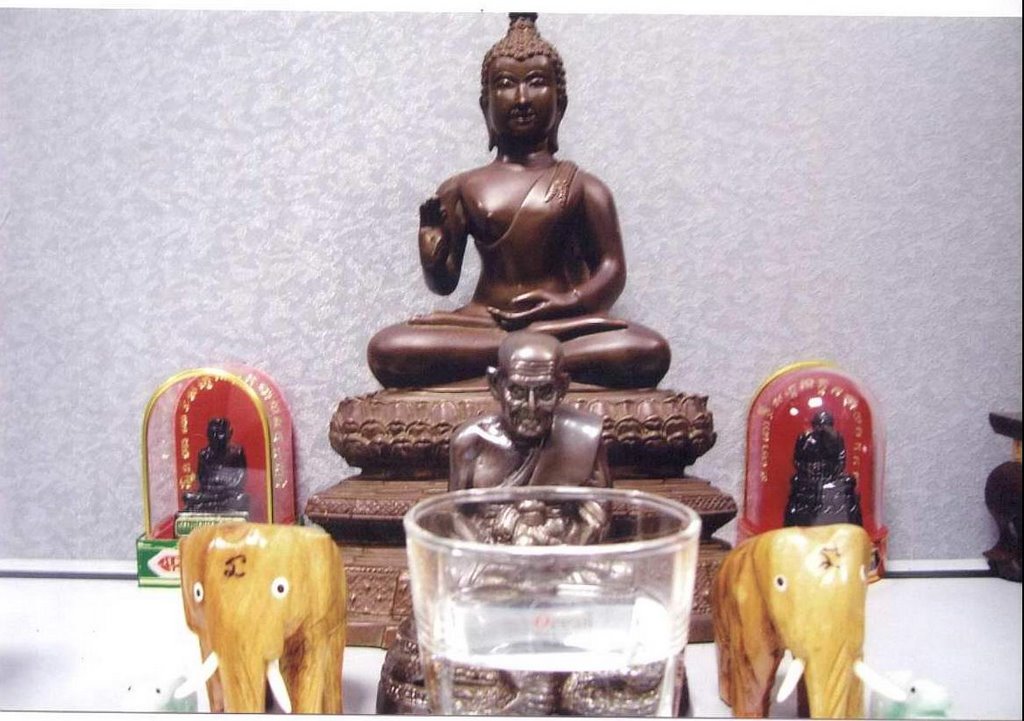
My Office Altar

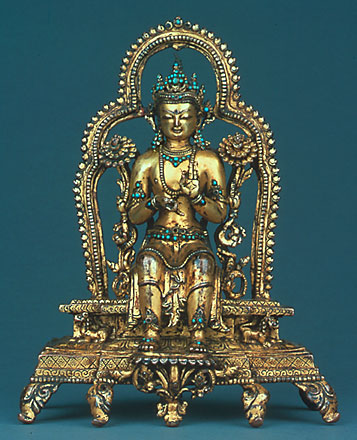
Recently I've decided to set up a simple altar in my office cubicle, so I can venerate the Triple Gems on a daily basis. As it is an air-con room, I don't put any kind of offerings except for a glass of drinking water, which I change every Thursday - the Day of Teachers. Fortunately, none of my colleagues seem to mind the Buddhist art on display. The main images of this altar consist of: 1) A bronze 5-inch bucha of Shakyamuni Buddha seated in the full lotus position and showing the "Vitarka Mudra" (gesture of discussion or transmission) with his right hand. There's a story on how I found this bucha, but I shall talk about it later.
2) A bronze 3-inch bucha of LP Tuad in a seated in a half-lotus position & holding an orb. There's also a King Cobra encircling his seat. Sharp eye readers would know this a the signature LP Tuad image from Wat Pako in Songkhla. I got this bucha on my 2nd trip there last year (2006).

3) 2 small 1.5-inch mini buchas (meant for putting in cars) of LP Tuad flanking the main Buddha image. The one on the left is from Wat Changhai, the place where LP Tuad attained enlightenment, & the one on the right is from Wat Saikow, where Ajarn Nong resided. Both temples are in Pattani.

4) 2 wooden Elephants & 2 jade Pixiu flanking LP Tuad, serving as protectors.

Yup that's basic setup. Feel free to give me your comments.

Regarding the main Buddha bucha, I actually found it months ago lying on the road being sold by an old man in the Sungai Rd flea market. It immediately caught my eye as it was totally different from most of the other poorly made Buddhist images found there. As you can see the casting was detailed, well defined & proportionate - a masterpiece of Buddhist art. I knew in my mind that this was the Chiang Saen - Lanna style of Buddha images to be found in Northern Thailand, but I did not know the name of this image or the temple that it might have come out from. How such a great bucha end up being sold in such a dirty & undignified state was a mystery to me. Without a second thought I decided to "rescue" it from the flea market. I bargained with the old man and took it at a real affordable price.

At home I meticluously cleaned the bucha, but found that the cement stuffing under the bucha crumpling in a few places. Unperturbed, I wrapped it up with a cloth bag, and on the very next day carried it to the Burmese Temple at Ah Hood Rd to let a Venerable there to conduct a consecration. Only then did I took it back to my office & place it on my cabinet. Although that settled the bucha, in my mind I was still eager to find out its origins.
It was only until yesterday (7.1.2007) that I realized where it came from. While surfing a tourism website of South Thailand http://thailand.sawadee.com/south_of_thailand/index.html
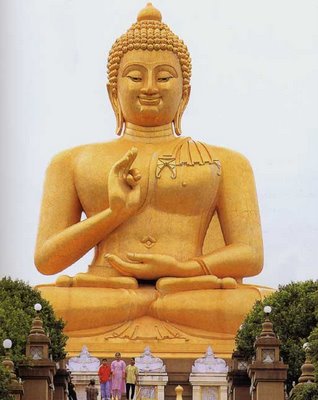
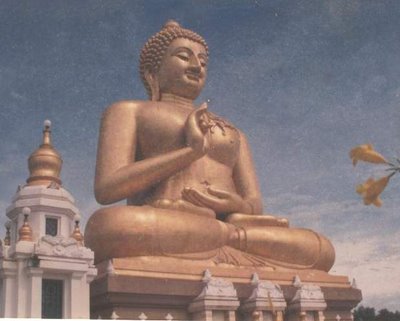
I saw that it was a replica of the famous "Phra Buddha Taksin Mingmongkon" statue in Wat Kaokong, Narathiwat province! Located 6 km away from town, on the Narathiwat-Rangae Road, this large seated Buddha image is covered with golden mosaic tiles, 24m high and measures some 17m from knee to knee. A magnificent object of veneration indeed!
The temple used to be visited by many tourists, but since the terrorist insurgency began in the South a couple of years ago, it has become quite deserted. However, it is precisely due to the atmosphere of fear pervading the whole region that the significance of this Buddha becomes more striking. With all the bombs exploding here & there, & with so many innocent people getting killed; yet the Buddha continues to sit there calmly, transmitting the Dhamma to all beings who still come to take refuge. Do you see the powerful contrast of imagery there? The fact that I came to obtain a bucha of Phra Buddha Taksin reveals the karmic affinity I have with this Buddha.

Strangely enough, I've also discovered that I'm linked to Amoghasiddhi Buddha of the Vajradhatu Mandala during a recent Kagyud blessing ceremony conducted by the 17th Karmapa. Amoghasiddhi Buddha, green in colour, is also portrayed as seated & showing the Vitarka Mudra, exactly like Phra Buddha Taksin. In the Vajradhatu, he represents the all accomplishing wisdom of the Dharmakaya. How does all these events link up with me?

Although I do not see the complete picture now, but inspired by this affinity, I've vowed to visit Wat Kaokong in Narathiwat once the situation in the region becomes more stablized. As difficult as it is, I do sincerely pray that the terrorists in the South will eventually give up the butcher's knife & make peace with the Thai government. Sadhu.

Saturday, January 06, 2007

Naga or Oarfish?

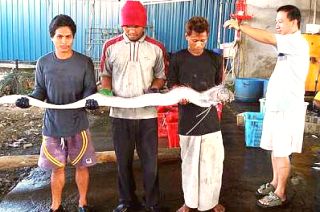
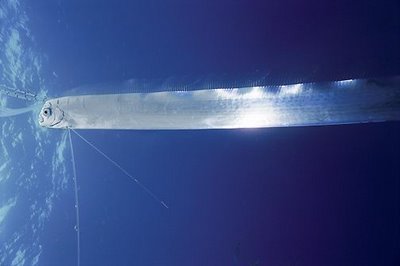
Last Saturday (30.12.2006) Malaysia's Mun Sang Poh paper did a report on a strange Naga like creature caught by fishermen at Pantai Remis on Dec 15th, about 70km from Ipoh. The 2.1m long fish has such a strong resemblance to the mythical creature that the fishermen who hauled it up was reluctant to identify themselves for fear of it bringing bad luck. However they were eventually identified, as shown in the photo below.They had originally intended to send its body to a taxidermist for preservation, but called off the idea under advice from a village medium. Instead they were instructed to return the "Naga" carcass to the sea, which they dutifully complied. Pantai Remis assemblyman Nga Kor Ming said that according to local superstition, the fish was one of the "family members" of a Sea Naga King. "If you kidnap the Sea Naga King's children, you are looking for trouble," he said. The fishermen so deeply believed in this theory that they even turned down a RM50,000 offer to part with the dead creature!
This type of "Naga", which has "dragon whiskers", red dorsal fins and a long, silvery body, is actualy an Oarfish (Regalecus russellii). The rare oarfish is reputed to be the longest of bony fishes in the world. It is not surprising that the fishermen know nothing about it, because oarfish seldom come to the surface of the sea. They only do so when they are sick or dying. Many other legends are woven up surrounding the capture of a Naga-like oarfish. People say that this kind of creature was seen beached before the Tsunami disaster happened 3 yrs ago. Incidentally, this oarfish was also caught before the recent earthquake in Sumatra. So there is definitely some link between seismic movements on the seabed & the sighting of oarfish. Some people also believe that the massive floods in Johor 2 weeks ago was due to the Sea Naga King's anger over the death of one of his children. Using his elemental powers, the Naga King caused a mighty storm in revenge, flooding the entire state of Johor. Could the floods be linked to the oarfish as well? Unlikely, as Johor is too far from Pantai Remis & it would be hard to build any relation between the 2 events.
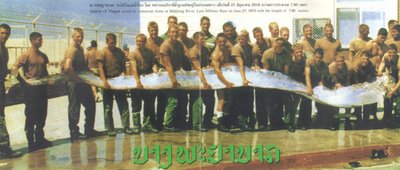
This story also brings to mind this widely circulated photo in Thailand, supposedly of the "Queen of Nagas seized by American Army at Mekhong River, Laos Military Base on Jun 27 1973". The creature seen in the photo is also an oarfish, but it is much bigger than the one caught in Pantai Remis. This oarfish is 7.8m long! There is also a legend surrounding this picture saying that those soldiers shown in the photo had all died as a result of the bad karma caused by killing a Naga. But the myth has been debunked some time ago. This photo was identified by one of the guys in it - 30 yr old Andy Z. According to Andy this was taken on Sep 19 1996 at the Naval Special Warfare Center, Coronado, California. "We were on our morning physical fitness run," Andy recalls, "when we came across this huge fish lying on the sand." At 23 feet in length and 4 feet in circumference, it was quite a shocking sight for the Navy SEAL cadets. Not suprisingly, the photo has been modified in Thailand to make the oarfish more convincing as a real Naga.

The Buddhist point of view is that it is not possible for ordinary humans to see real Nagas or their children for that matter, for they are a race of serpent-like demi-gods with bodies much more subtle than any human or animal. Given their powers it is impossible for a man to catch them. They can shape-shift at will and often appear in a human form when speaking to the Buddha or his Noble Ones. Thus only those meditators with divine eye can perceive these beings. But if we think of oarfish as their closest looking servants, then we have an idea what their true form resembles. As for the earthquakes and floods in Malaysia and Indonesia, they are not caused by the Nagas or their servants, but by the collective karma of the sentient beings in the respective regions. Know that natural phenomena and the mental state of beings are deeply related. The more impure our minds are, the more disasters we will experience. But if we can return the mind to it original purity, peace & protection will always be by our side.

Sunday, December 17, 2006

Peculiar Photos taken in Thailand

The Avatamsaka Sutra says:

"The Buddha's body fills all things,
Appearing universally before all sentient beings;
Depending on causation & responding to feeling it never fails,
Yet always remaining in the seat of Enlightenment."

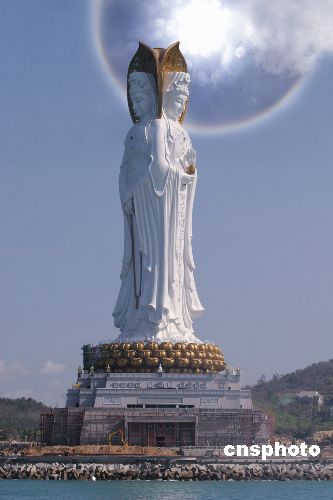
One day at 11.30am, 13-5-2005, inside the Nanshan tourist area of Sanya in Hainan Island, China, the skys quickly turned into a deep blue colour. Five mins later an incredible halo of light started to appear in the sky right about the great 3-sided standing Guanyin statue by the sea (as seen in the photo above). It lasted for around 40 mins & almost a thousand tourists witnessed this amazing sight. Those with cameras snapped incessantly, & Buddhists & non-Buddhists alike were filled with awe. Was it a manifestation of Guanyin like the Buddhists believe? Or was is a natural phenomena caused by changing climate & evaporation like the scientists say? Those who understand the Dharmakaya will see that these 2 explanations are not in contradiction with each other.

There was a small report on the above incident in the Chinese papers last year, but I think not many people could remember it. So I would like to show you 2 photos of mine taken in Thailand in recent times. This photo of LP Tuad's wax statue, taken at one of the the shrine halls of Wat Pako in Songkhla, is where they hold the sacred crystal orb given to him by a Naga when he was still a baby. Notice the many white orbs of light floating about in the picture. They cannot be found in any of the other photos that I have taken at Wat Pako. Many people believe these orbs of lights to be spirits, invisible to the naked eye but sometimes able to be captured by the camera. I do believe that wherever there is a site of great power, there tend to be many invisible beings assembling there to pray & pay homage, just like us humans. Cynics will say they are lighting & camera faults, but unless they can provide strong scientific evidence proving otherwise, why should anybody take their word for it?
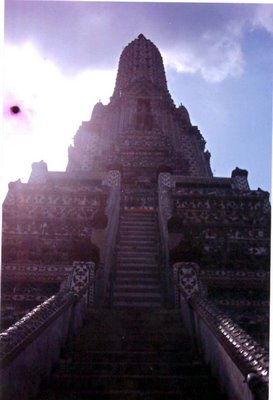
Another photo I found special is this Chedi taken at Wat Arun in Bangkok. See the dark purple orb in the sky on the left side of the photo? What could it be? Perhaps the Sun, but the Sun could not be purple in colour right? Could it be some sort of Deva? Its glory does surpass the small white orbs seen above by many times. I leave this for readers to ponder themselves.

A Glimpse of the Buddha-nature

The Avatamsaka Sutra says:

"Such as the True Thusness, which is a body of shining light."


A couple of days ago, while dozing in my chair, I had experienced for myself what the above verse means. My mind was in a dreaming state when suddenly I found myself engulfed by a nimitta (mental image) of very powerful light, covering the entire dream universe. For a short period of perhaps 10 secs, I experienced a profound bliss, something which I have never experienced before in my life. Could this be the infinite light of our true mind, the Buddha-nature? Is this the same light that people see when they have near-death experiences (NDE) or when they first enter the Bardo state (described in the Tibetan Book of the Dead) after death?

Whatever it is, it was quickly over and my mind fall back into its normal dreaming state, after which I woke up in a short while. I believe the entire episode only lasted a few minutes, but it left a deep impression on my mind.

I read in the past when some practitioners experience this clear light they find themselves losing all sense of time & space. One guy related that he was walking to his car in the car park from his office when he suddenly had this awakening experience. His conceptional mind was dissolved at the moment and a walk that normally took 5 mins was reduced to like, a few seconds. This is also the same as meditators who enter Jhana for hours, but they themselves thought that it was only a few mins. Here is a story to illustrate this point:

One autumn, Ven Xuyun was travelling with a companion when he decided to rest in an abandoned hut for the night. He started a fire to boil water inside the hut, but while waiting for the water to boil, his mind converged into Samadhi there & then. When Ven Xuyun came out of the state, the fire was long dead and the water in the pot was already frozen, because it was already winter! Not knowing what happened he asked his companion who happened to be sitting nearby. The companion informed Xuyun that he had been sitting by the fire place for more than a month. Knowing that he would eventually "wake up", & not wishing to leave him just like that, the monk had somehow waited in the vincity faithfully all this time. Ven Xuyun was quite surprised to hear that, but he also had new found respect for his companion. This story tells us that the true mind is beyond all physical laws. Concepts of size, distance, time, space cease to exist, overrided by the omniscient & omnipresent virtues of the Buddha-nature.

The Buddha & all the Noble Ones must have experienced the same thing when they attained enlightenment, but at a much more intense & permanant level. I may still have a long way to go, but surely I too, will attain enlightenment in this lifetime if I never give up my Dharma practice. Let us all work hard.

Friday, December 15, 2006

Holy Wars & the End of the World

The Dhammapada says:

"Just as one would look upon a bubble,
Just as one would look upon a mirage;
If a person thus looks upon the world,
The Lord of Death sees him not."

All religions, especially monothestic ones like Islam & Christianity talk about Holy Wars & the End of the World. But what about Buddhism, which does not believe in violence or an Almighty God that creates & destroys the world? Surprisingly, there are such concepts in Buddhism, but they are nothing like what the other religions conceive them to be.

In Buddhism, the only "holy war" is the war with your own mental defilements like craving, hatred & ignorance. But unlike other wars, we do not seek to destroy these enemies, which are in reality part of ourselves. When we practice the Dharma, we seek to transform our defilements, not fight with them. Thus craving becomes contentment, hatred becomes compassion & ignorance becomes wisdom. In this way a sentient being is no different from the Buddha.

There is a also a concept of the end of the world, but the end is not really the end because all worlds go through the 4 stages of becoming & dissolving in an infinite cycle, in the same way as sentient beings live & die again & again in Samsara. However, the lifespan of our world is so long that the end is unimaginable to an unenlightened mind. Currently, we are in the Bhadda Kappa (Virtuous Aeon) and there would be 1000 Buddhas appearing in this aeon. From Kakusandha Buddha to our current Shakyamuni Buddha, only 4 Buddhas have appeared, and there are 996 more to come. From one Buddha to the next, there is an in-between period of around 5.76 billion yrs (according to the scriptures). Since no human can ever live to see the next Buddha - Maitreya, let alone all the other future Buddhas of the age, worrying about the end of the world is totally pointless.

What is really important is for us humans is to make the best use of our present existence to try to reach, or at least get as close as possible to Nibbana, the end of suffering; otherwise our time on earth would have been wasted. Once our fleeting lives come to an end at any time, we may no longer have a chance to hear & practice the Dharma in our next existence. Who knows how long do we have to suffer in the Samsaric cycle before we are reborn in favourable circumstances again?

Saturday, December 02, 2006

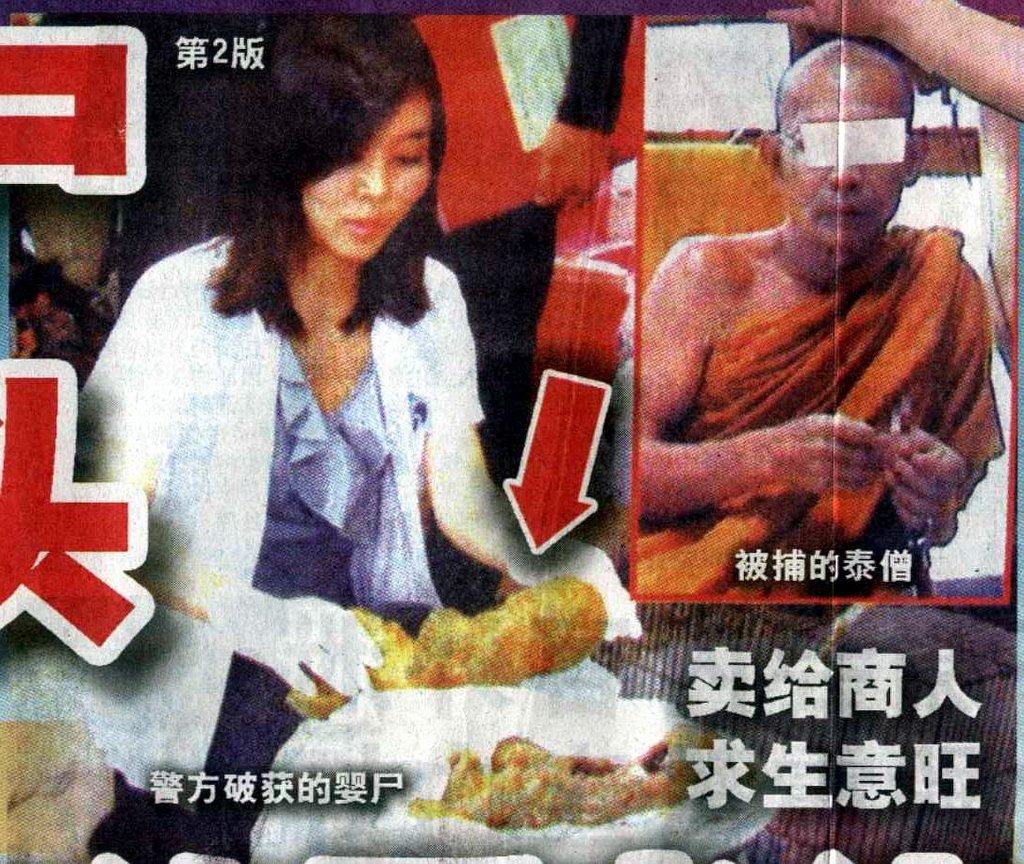
Thai Abbot arrested for roasting baby corpses

The Wanbao paper yesterday (01-12-2006) reported that a Thai abbot (pic shown above) from Roi Et province in Northeast Thailand (Isan) was arrested for roasting 2 baby corpses (indicated by the arrow) to make Lukkok. These Lukkok are then sold to businessmen as child spirits to attract wealth, for as much as 10,000 baht per corpse. This case reminded me of the necromancer Nain Ae, who was jailed years ago for a similar offence.

This abbot is around 60 yrs old & has been a monk for 30 years. He has 2 disciples living in the temple with him, 1 male & 1 female. According to the paper, the abbot does not beg for alms, chant & meditate like normal monks, but instead he had travelled widely to neighbouring countries like Laos, Cambodia & Burma to learn Black Magic. After the baby corpses were roasted, he would use his knowledge of the dark arts to transform them into Lukkok. This macarbe practice was discovered when the police visited their small temple for a routine check. Apparently the abbot has been doing it for some time, but his karma has finally caught up with him & now he has to face the legal consequences of doing things like that.

The Vinaya says:

"Whereas some priests and contemplatives, living off food given in faith, maintain themselves by wrong livelihood, by such lowly arts as:

..offering blood-sacrifices;
making predictions based on the fingertips;
geomancy;
laying demons in a cemetery;
placing spells on spirits;
reciting house-protection charms..

The Bhikku abstains from such wrong livelihood, from lowly arts such as these."

When a person puts on the saffron robe of the Sangha, yet practices such lowly arts such as black magic for a living, he is really without any sense of shame. Instead of training his body, speech & mind in the Dharma, he roasts babies to sell to foolish lay people. Mired in the swamp of wrong livelihood, does he not realize that the demons of Hell are also waiting to roast him after he dies? Woeful indeed!

In the Dharma Ending Age, the servants & children of Mara are everywhere, including those who have infiltrated into the Sangha and tries to destroy it from within. If we are ignorant enough to follow such imposters, we invite suffering upon ourselves for nothing. The importance of finding the right teacher in the Buddha Dharma can not be stressed enough.

Monday, November 27, 2006

Commentary to the Heart Sutra Part 3

A Bodhisattva, relying on this Prajna Paramita, is free from all hindrances as they too, are empty.

1. The Prajna Paramita that can be relied on is not the real Prajna Paramita. If a Bodhisattva needs to rely on anything at all, then we should kick him out of the window! We ourselves are Prajna Paramita; complete with all Dharmas, lacking in nothing. Why speak as if it is something outside for us to depend on? If we think that there is something to rely on, then we will forever be seeking external objects & be blind to our own Buddha-nature. This is the path of Samsara.

Ven Linji once went to visit Bodhidharma's tomb. The keeper asked him:
"Does the Ven wish to pray to the Buddha first, or to the Patriach (Bodhidharma)?"
Linji: "I will neither pray to the Buddha, nor to the Patriach."
Keeper: "What grievances to you have with the Buddha & the Patriach?"
At this point, Linji laughed, shook down his sleeves and left, leaving the keeper in puzzlement.

The Buddha & the Patriach both taught us to look within our own minds for the Truth; how could Linji do otherwise?

2. The hindrances generally refer to (a) sensual desire, (b) ill-will, (c) sloth & torpor, (d) restlessness & remorse, (e) sceptical doubt. They hinder one from seeing the true nature of the mind, for they are manifestations of Avijja. But if a person can in an instant, realize directly that there is no mind, then what can these hindrances hinder? That's why the 6th Patriach said that:

"Bodhi has no tree,
The Bright Mirror is not a stand;
Intrinsically there is nothing,
Where can dust alight?"

If one has a mind, one is sure to have mental dust; when one has mental dust, one is sure to have 84,000 kinds of kleshas. One may sweep off the dust now & then, but after a while new dust gathers once more. This is just another a never-ending cycle which is not in line with the Dharma. Like trying to cut a fountain of water with a sword, you will never succeed as new water constantly flows out from the source. Why not go directly to the source? That is the only way to go!

Free from all fear and apart from inverted views, he reaches Final Nirvana.

1. This fear refers to the fear of birth & death, the fear of suffering. When one realizes all encompassing emptiness, birth & death becomes non-dual with cessation. Whether one comes or goes, the Buddha-nature remains unmoved. Like an illusionary man created by an illusionist, the illusionist feels no fear at all with the arising & dissappearing of the illusion. This is because he knows that the man is intrinsically unreal.

2. Inverted views refer to the 62 wrong views, consisting of the 5 aggregates considered under the 3 eras of past, present & future. In the past, each aggregate may be permanant, impermanant, both & neither (5 x 4). In the present, each aggregate may be finite, infinite, both or neither (5 x 4). In the future, each aggregate may continue, discontinue, both or neither (5 x 4). That adds up to 60. Plus the 2 views that the body & mind is either united or separate, we have the 62 wrong views. However after one sees the Buddha-nature, the 5 aggregates return to emptiness, as well as all concepts of time & space. Thus all the 62 wrong views can no longer be established.

3. Final Nirvana refers to Parinirvana or Nirvana without remainder. Contrary to what most people understand, Parinirvana does not refer to the manifestation of death of the enlightened ones, but the Unborn & Undying virtue of the Buddha-nature. Thus the Vimalakirti sutra says:

"All Dharmas fundamentally do not arise,
And thus they also do not enter into cessation;
That is the meaning of Nirvana."

The Parinirvana Sutra says:

"The teaching of Impermanance,
Still falls under the realm of duality;
Only when duality is no more,
Can one realize the bliss of Nirvana."

As such, all duality, birth & death & the 5 aggregates are absorbed back into the Absolute & simply become means for the Dharma to reveal itself to sentient beings. That is why the enlightened being lives in complete freedom, doing anything he wishes, preaching only when the opportunity arises & passing away in any manner & at any time he chooses. Like a jester, the Bodhisattva displays various activities among the world as if they are games, but in these games contain the direction that leads beings to the highest truth.

In the past Ven Long Tan went to study Zen with Ven Tian Huang. After staying for a long time, Long Tan asked Tian Huang:
"Master, after coming here, I've yet to receive any instruction from you."
Huang: "Since you came here, I've never neglected instructing you in the essence of the mind before."
Tan: "Where have you given me any instructions?"
Huang: "When you bring me a cup of tea, I drink it. When you bring me my meals, I eat them. When you salute me, I nod my head. Where have I not given you instructions?"
Tan lowered his head to think about what his master said. At this point Huang shouted:
"To see the Truth, you must see it right now! If you try to think then it is already gone!"
Tan attained enlightenment upon hearing these words.

Thus you see that there is not a single moment that the Bodhisattva does not teach the Dharma, but sentient beings simply could not catch the hint!

All Buddhas of the 3 eras (past, present and future) also rely on Prajna Paramita to attain anuttara-samya-ksambodhi (complete enlightenment).

1. What are the Buddhas of the 3 eras? The past thought does not arise is the past Buddha. The present thought does not stay is the present Buddha. The future thought does not cease is the future Buddha. The Diamond Sutra says:

"The past mind cannot be found,
The present mind cannot be found;
The future mind also cannot be found."

That which neither arises, abides nor ceases is the true Buddha - your own Buddha-nature.

2. The Buddhas do not rely on Prajna Paramita. Why? They themselves are Prajna, they themselves are Paramita! If they still need to rely on anything at all, then they cannot be called Buddhas.

In the Manjusri Prajna Paramita Sutra, the Buddha asked Manjusri:
"Have you gained all-prevading wisdom?"
Manjusri: "I myself am this all-pervading wisdom. Why would I need to seek it anywhere else?"

This sutra is full of traps. If you are not sharp enough, you will fall right into them and cannot escape.

3. There's no Dharma called anuttara-samya-ksambodhi or complete enlightenment. What more for its attainment? All there exist are names without any real meaning at all. The Buddha said:

"If I have gained any Dharma at all from Dipankara Buddha, then Dipankara Buddha would never have given me his prophecy (of future Buddhahood)."

Nothing gained, nothing attained, nothing lost, nothing denied. That is the true meaning of complete enlightenment.

Therefore know that Prajna Paramita is the great divine mantra,

1. Mantra are syllables & words of Truth that contain immense power, able to alter the conventional laws of reality when spoken by the right person. The Nobles Ones, sometimes even ordinary people, were able to perform what we perceive as miracles by reciting certain words of Truth. However, in this case, Mantra refer to all the inconceivable Dharma that issue forth from our Buddha-nature. This Mantra is wordless, formless, featureless and One with the Absolute. The sutras say:

"Only the Enlightened & other Enlightened Ones can know it."

2. Great divine mantra refers to the supernormal powers of the Buddha-nature. Traditionally, there are 6 supernormal powers. But these powers have a different meaning when discerned by Prajna Paramita. Ven Huihai once said:

"The Divine & Complete Buddha-nature,
Is omnipresent in all the infinite world systems;
Be there mountains, rivers, rocks or walls,
It comes & goes without obstruction."

i) Divine eye - all that one sees is the unborn & undying nature of the mind. The scriptures say:

"See that the mind is without appearance, see that the Buddha is no different."

ii) Divine ear - all that one hears is the Dharma of the Absolute. The scriptures say:

"The grass, the birds & the forests; all of them can recite the Dharma."

iii) Knowledge of the minds of others - knowing that all the minds of sentient beings are no different from the minds of the Buddhas. Upon his enlightenment, the Buddha exclaimed:

"Wonder of wonders! All sentient beings possess the wisdom-virtue of the Tathagata, yet they cannot see it due to their own kleshas!"

iv) Transformation at will - the complete freedom of the Buddha-nature to reveal itself through any worldly or non-wordly means. The scriptures say:

"Every plant & tree, every grain of sand & stone;
Not a single object here is apart from the Bodhisattva's manifestations."

v) Knowledge of past lives & future destiny - knowing that all the Buddhas & Patriaches of the past, present & future have & will continue to walk the same path, understand the same Truth & preach the same doctrine; for there is no Dharma other than the Mind. The scriptures say:

"All the Buddhas of the 3 eras, share the same Dharmakaya."

vi) Freedom without remainder from the wheel of Samsara - understanding without a doubt that the Mind is Samsara, the Mind is Nirvana, the Mind neither comes nor goes, increases of decreases. No less than the dissolving of all duality & complete realization of emptiness. The Dhammapada says:

"Dwelling in the cave (of the heart),
The mind, without form, wanders far and alone.
Those who subdue this mind,
Are liberated from the bonds of Mara."

These are the 6 supernormal powers of the Buddha-nature, the great divine mantra.

the great bright mantra, the supreme mantra, the incomparable mantra.

1. Bright in this verse refers to the brightness of 3 Vijja or super knowledges. What are these 3? They are actually part of the 6 supernormal powers explained earlier, namely:

i) Divine Eye
ii) Knowledge of past lives & future destiny
iii) Freedom without remainder from Samsara

The difference between the power & the knowledge is that the latter is far more penetrative than the former, because is no longer hindered by coarse or even subtle kleshas, thereby regaining its full clarity. Worldly yogis, rishis & devas may also have supernormal powers, but only the enlightened ones possess the 3 super knowledges. In the case of Prajna Paramita, however, there is no such difference. The powers & knowledges of the Buddha-nature are completely One.

Once there was a Rishi who have attained the 5 supernormal powers asking the Buddha: "World-honoured One, you possess the 6 supernormal powers, whereas I only have 5 powers. What is the 6th power?"
The Buddha suddenly exclaimed: "Rishi!"
The Rishi answered: "Yes, lord?"
Buddha: "That power; why do you ask me?"

The 6th Power, the 3rd Knowledge, Prajna Paramita, all refer to the same thing. Do you know what is it?

2. Supreme refers to the omnipresent quality of Prajna Paramita. There is nothing above it or outside of it. Like the Avatamsaka Sutra said:

"Such as the True Thusness, which is present in all places.
Transference of good roots is likewise,
In a single thought moment, it reaches all world systems."

Because the nature of the mind is such, it can reach places like the Pure Land of Amitabha in a single instant, even though it is "10 billion world systems" away from our Saha world. If the mind was not so, then all our practices would have been in vain. Thus, you can see that space & distance are merely illusions.

3. Incomparable refers to the quality of omniscience. Because all Buddhas & sentient beings share the same Buddha-nature, they also share the same infinite wisdom. In terms of the Absolute, the mind, the Buddhas & sentient beings are One. Why is this so? Because in the Absoulte there is no Mind, no Buddhas & no sentient beings. Thus the scriptures say:

"Prajna in Unknowing,
Yet there is nothing it does not know.
Prajna is Unseeing,
Yet there is nothing it does not see."

Profound indeed is Prajna Paramita. There is nothing comparable to it in the entire Dharmadhatu. If you can see directly into where there is no mind, then this whole universe will become your playground.

Able to remove all suffering, because it is one with reality & free from all falsehood.

1. It removes all suffering because it shatters false clinging to a sufferer. When there is no sufferer, where can you find suffering?

Once Ven Baizhang & Ven Mazu were strolling together in an open field. Suddenly a bunch of wild geese flew by overhead. Mazu asked Baizhang:
"What are those?"
Baizhang: "Wild geese."
Mazu: "Where are they now?"
Baizhang: "Flew away."
Suddenly, Mazu pinched Baizhang's nose as hard as he possibly could. Baizhang screamed in pain!
Mazu: "Clearly still around! Since when did it flew away?"
Baizhang was immediately awakened after hearing these words.

Baizhang realized at that point that which does not suffer. Can you also see it?

2. What does it mean by being real & free from falsehood? Ven Xuanjue said:

"The freed cultivator who ceases all learning & becomes non-active,
Does not remove false thought nor does he seek reality.
The nature of fundamental ignorance is the Buddha-nature,
The illusionary & empty body is the Dharma body (Dharmakaya)."

All falsehood becomes reality in the absence of discrimination. Why? Because both falsehood & reality is not apart from emptiness. As such, there is neither falsehood nor reality - that is the true reality! Besides this true reality, I still have one more piece of Dharma to share with you. What is it? The tree behind my house is almost 90 feet tall.

To recite the Prajna-paramita mantra, say it thus:
"Ga-te, ga-te, para-ga-te, para-sam-ga-te, bodhi svaha."


Ah yes, the final part of the Heart Sutra, to recite that which is beyond words. Ga-te is a Sanskrit word meaning "Gone". Gone where? Gone to where there is neither coming nor going, where there is no birth & death, no entanglement & no liberation. Para-gate means "Gone beyond" & Para-sam-gate means "Totally gone beyond". Bodhi means enlightenment, svaha means to acheive. The whole verse of mantra means "To achieve enlightenment when you have totally gone beyond". The key word here is Ga-te. All the rest are merely emphasis words for the word Ga-te. If people ask you whether there is a single word that contains the essense of the whoe Heart Sutra, say there is none. But if they are still not satisfied, tell them it is the word Ga-te. If they ask for instruction on how to practice, tell them to meditate on the meaning of Ga-te. This is the final skillful means taught by the Heart Sutra. Remember it well!

With that, we have come to the end of this commentary. Although not a single word has been said, may it still be beneficial to all beings who bother to read it. May the blessings of all Buddhas be unto you all.

Sunday, November 26, 2006

Commentary to the Heart Sutra Part 2

Shariputra, all Dharmas are empty. They are beyond birth and death, impurity or purity, increase or decrease;

1. Shariputra, all Dharmas are empty - of things that owe their existence to causes & conditions, they are empty of any real nature, like illusions, like mirages, like echos. Whether they last one split second, or even if they last thousands of kalpas, in the end all dissolve back into emptiness. The Diamond Sutra said:

"Of all conditioned things,
They are like dreams, bubbles, shadows;
Like dew & like lightning,
So should you perceive them."

Because they are empty, they cannot be grasped to. That which cannot be grasped is no different from the Buddha-nature.

2. They are beyond birth & death, impurity or purity, increase or decrease - the body of the Buddha is adamantine in nature. It is fundamentally unborn, & thus also undying. Being free from impurity, thus it also need no purity. Originally perfect, how can there be any increase or decrease? What is this Buddha body? None other than your own true mind! The 6th Patriach said:

"Who would have thought that the Self-nature, is intrinsically pure!

Who would have thought that the Self-nature, is intrinsically free from birth & death!

Who would have thought that the Self-nature, is intrinsically self-sufficient!

Who would have thought that the Self-nature, is intrinsically immovable!

Who would have thought that the Self-nature,can produce all Dharmas!"

Absolute is the Buddha-nature; Relative are birth, death, impurity, purity, increase & decrease. There is no room for the Relative in the Absolute, because all relative things that come into contact with the absolute are transformed into the absolute. Like snow flakes melting into a burning stove, or like smelling only the fragrance of jasmine when you enter a jasmine grove. The Buddha-nature is called Absolute as it is the ultimate reality. It stands on its own without need for any relative truths or what is known as duality. That which is non-dual is the Prajna Paramita of the Buddhas.

Because in emptiness there is no form, no feeling, perception, habit and consciousness. No eyes, ears, nose, tongue, body and mind. No vision, sound, smell, taste, touch, and thought. No sphere of vision and so forth, not even a sphere of consciousness.

1. Because in emptiness - refers to the Absolute, the Buddha-nature, the true mind. There is nothing outside of it, yet it is neither within, without or in-between.

Ven Guishen once asked Ven Wenyi:
"See that big rock in the garden. You said that everything is within the mind; so is that rock within your mind, or without?"
Wenyi: "Within my mind."
Guishen: "You are a wandering monk & should travel light. Why carry such a big rock in your mind when you travel about?"

Wenyi was not able to reply. He stay with Guishen for more than a month to contemplate, but could not come to any realization. Finally when he ran out of answers completely, Guishen gave him a relevation:

"If we talk about the Dharma, everything is in the present moment."

Wenyi attained enlightenment upon hearing that, & went on to become the founder of the Fayan branch of Chan Buddhism.

2. There is no form, no feeling, perception, habit and consciousness - the 5 aggregates cannot stand within the Absolute.

3. No eyes, ears, nose, tongue, body and mind - refers to our 6 sense organs.

4. No vision, sound, smell, taste, touch, and thought - refers to the 6 sense objects.

5. No sphere of seeing and so forth, not even a sphere of consciousness - refers to the 6 sense spheres. When you break down the aggregates into subject & object, you get these 18 spheres. The 6 sense organs are the subject of Form, & the 6 sense objects are the object. When they interact with each other, you get the 6 sense spheres. From their interaction produces feeling, perception, habit & consciouness. No matter how you break them down, they still cannot stand within the Absolute. Mind, Buddha, Sentient beings; these are merely false names & also have no place in the Buddha-nature. Thus Ven Zhaozhou said:

"I don't like to hear the word Buddha!"

That being said, know that the nature of these 5 aggregates & 18 spheres are not apart from the Buddha-nature. Because they are empty, they are also non-arising & non-ceasing. Before we are enlightened, these aggregates & spheres are ruled by Avijja, creating all sorts of karma which causes Samsaric suffering. But after we are enlightened, they are dissolved back into the Absolute & simply become instruments for the Buddha-nature to reveal itself. Thus Ven Baozhi said:

"The Great Way is right before you,
Yet it is difficult for you to see it;
If you wish to know the body of the Great Way,
Do not seek them apart from form, sound & language."

The body of the Dharma cannot be grapsed, just as the body of all things are empty and also cannot be grasped. Thus it is called "Nothing". Yet within this nothing contains infinite wisdom & applications. Whether body or application, they are still One & the same thing, don't you see?

No ignorance or its extinction, not even aging and death and their extinction.

1. This verse refers to the 12 causal links of existence, namely: avijja (ignorance) - mental formations - consciousness - mind & matter - 6 sense bases - contact - feeling - craving - clinging - becoming - birth - aging & death. These links binds us to the wheel of samsara, leading us through the never-ending cycle of birth & death. The root cause of these 12 links is Avijja & it has been obscuring the Buddha-nature since time immemorial. Like the Buddha-nature, Avijja is without a beginning. But unlike the Buddha-nature, it can come to an end. Once Avijja is shattered, all the 12 causal links collapses; for they too cannot stand within the Absolute. Despite having obscured the true mind for so long, Avijja could not affect the purity of the Buddha-nature even one bit. All the infinite past lives of samsaric wandering appear to be like yesterday night's dreams. Once Avijja is shattered, there is no chance of it ever coming back, just as an enlightened person will never become deluded again. The Sutra of Complete Enlightenment says:

"Good man, it is like refining a piece of gold ore. The gold within does not come from refining, but once gold ore is refined into pure gold, it never becomes ore again. No matter how much time have passed, the nature of gold does not deteoriate. Thus you should not say it is not perfect from the beginning. The Complete Enlightenment of the Buddhas is no different."

Gold ore refers to the Buddha-nature obscured by Avijja, & pure gold refers to the Buddha-nature itself.

2. Those who realize enlightenment by themselves, breaking Avijja without any guidance are called Paccekas or Solitary Buddhas. Although they are enlightened, their enlightenment is incomplete because they still have a subtle clinging to the aspect of cessation in the Buddha-nature. They see only the body of emptiness, but they do not see its infinite applications. Thus they become stagnant, losing their inherent Prajna and are unable to preach the Dharma to others. Although the scriptures say they are superior to the Savakas, in the eyes of the Absolute they are no different - both are rotten seeds, content with dwelling in illusionary cities instead of the true mansion of the Tathagatas. Thus the Lotus Sutra says:

"In all the Buddha-lands,
There is only One vehicle;
Neither a second or third exists,
For they are only skillful means."

What is that One vehicle? None other than your present mind!

No suffering, no origin of suffering, no extinction and no path.

1. This refers to the 4 Noble Truths. But they too cannot stand within the Absolute. Why is this so? Because Suffering can only be ebstablished upon a Sufferer. When you cannot find a self or even a no-self, what more for the concept of a sufferer? Thus you see that the Noble Truths that the Savakas rely upon to reach Nibbana are by themselves without any real nature, what more for the fruits of their path? That's why when Emperor Liang Wudi asked Bodhidharma:

"What is the highest meaning of the Noble Truths?"
His reply was: "Vast emptiness, nothing noble."
Wudi: "Who is the one speaking to me then?"
Bodhidharma: "I do not know."

Bodhidharma honestly revealed the Absolute to Wudi, but alas, he was not able to understand it.
No wisdom and no attainment; there is nothing to attain.

1. If the Absolute can have wisdom & attainment, then it is not the Absolute. The wisdom of the Buddha-nature is the wisdom of non-wisdom, which cannot be attained as it is inherent within the Buddha-nature itself. Our true nature is non-abiding, & therefore it is able to penetrate all things in all time & space. When we use it, we give it a false name called "Prajna"; when we don't use it, it is nameless, formless, & beyond all dual conceptions. If we have to name this body, we simply call it "Paramita", which is also another false name. But in reality there is neither Prajna nor Paramita for they are One & the same thing. In the Vimalakirti Sutra, Shariputra asked the Devi:

"Devi, how soon will you attain perfect enlightenment?"
Devi: "At such time as you, Elder, become an ordinary being once again, then will I attain perfect enlightenment."
Shariputra: "Devi, it is impossible that I should become an ordinary being once again."
Devi: "Just so, Ven Shariputra, it is impossible that I should attain perfect enlightenment! Why? Because perfect enlightenment is not something that can be attained."
Shariputra: "But the Buddhas of the past, present & future who have attained perfect enlightenment are as numerous as the sands of the Ganges. What will you say of them?"
Devi: "Ven Shariputra, the expression, 'the Buddhas of the past, present and future' is merely a conventional expression spoken in line with worldy thinking. It does not mean enlightenment is tied to the past, present or future. But tell me, Elder, have you attained arahatship?"
Shariputra: "It is attained, because there is nothing to attain."
Devi: "Just so, all Buddhas & Bodhisattvas attain perfect enlightenment because there is nothing to be attained."

Only when there is no wisdom & no attainment, can one truly see what is Prajna Paramita.

(to be continued..)

Commentary to the Heart Sutra Part 1

Homage to all the Buddhas & Bodhisattvas in the 10 directions. May they forgive & offer me repentance if I misunderstand their teachings; but if I may comment in accordance to the supreme Dharma, let this merit be transfered to all sentient beings in the entire Dharmadhatu, such that they may see their very true minds.

Sadhu, sadhu, sadhu.

Prajna Paramita Hridaya Sutra

1. What is Prajna? Prajna is often translated as wisdom. This wisdom is not ordinary worldly wisdom, but the wisdom to see all things as they really are. The scriptures say:

"Prajna does not know, yet there is nothing it does not know.
Prajna does not see, yet there is nothing it does not see."

The body of Prajna is empty like the void, yet in this void contains infinite applications.

"Able to differentiate all phenomena,
Yet remaining unmoved in the Utmost Meaning."

Prajna differentiates all things that comes into contact with it, yet it remains unattached to all things. This is the pure awareness quality of all Buddhas which Avalokitesvara wants all of us to discover in our own mind, which is also the central theme of the Heart Sutra.

2. Paramita - often translated as perfection, or crossing to the other shore.

"This shore" refers to samsara, suffering or delusion.
"Other shore" refers to nirvana, bliss or awakening.

But in reality there's neither "this shore" or "other shore". There is only one shore, the shore of the Buddha-nature, the shore of the Absolute that is freed from all duality. No samsara, no nibbana, no suffering, no bliss, no delusion, no awakening - that is the true Paramita, the true perfection & crossing to the other shore.

3. Hridaya - translated as essence, heart or mind. In Chinese, the character for heart & mind is the same & refers to the same thing.

"Heaven & hell is in the Mind, & so is Nirvana."

The mind is the origin & end of all things. Mind itself is the Buddha, mind itself is the Dharma; when they work in harmony you get the Sangha. When the mind returns in its original state of emptiness, it is called Paramita. From this state of emptiness one sees & knows all phenomena, that is called Prajna. In reality Prajna & Paramita is one & the same thing. Prajna is the Dharma, Paramita is the Buddha. When you combine them you have the Sangha. All these names are just different aspects of the one true Mind!

The whole Heart Sutra could have ended right here. That is all there is to teach. Like the 6th Patriarch said when he first started to preach: Maha Prajna Paramita. He fell silent after that. But seeing that nobody could understand that was all there is to it, he had no choice but to add:

"The Self-nature of Bodhi,
Is fundamentally pure;
With this very mind,
Enter straight into Buddhahood."

4. Which brings us to the term Sutra. Sutra means scripture or thread. Because sentient beings could not grasp the meaning of the wordless, the Buddhas need to use all sort of words as skillful means to refer people to this meaning, which Hui Neng described as "fingers pointing to the moon". The whole Tripitaka & the entire collection of scriptures in the Mahayana Canon are fingers. They exist because people can't see the moon by themselves. If they finally see the moon, then all these billions of words become useless.

Bodhisattva Avalokitesvara, deep in the practice of Prajna-paramita,

1. Yes Avalokitesvara is being long-winded like an old lady here, but he has no choice as people in the assembly could not understand what she wanted to teach. Bodhisattva means a being on the path to Buddhahood, a person seeking Bodhi. He is tricking us here, bcos Avalokitesvara knows very well that Bodhi or enlightenment could not be sought. Seeking brings us even further from our true mind; either u see it or u don't! He IS a Buddha, yet he goes around pretending to be a "Bodhisattva". Shame on him.

2. Avalokitesvara means he who observes the world with freedom (观自在 Guanzizai), or he who listens to the sounds of the world (观世音 Guanshiyin), commonly know as Guanyin. He is the embodiment of compassion in the Buddha-nature. This compassion is greater than the worldy humanism of Confucius & even the godly love of Jesus. How is that so? This compassion is one with the void, devoid of subject & object, self & other, giver & taker. It is what the scriptures described as:

无缘大慈,同体大悲。
Unconditioned Love, Non-dual Compassion.

This kind of enlightened compassion is untiring & everlasting, surpassing all love arising from religious or humanistic beliefs.

3. Deep in the practice of Prajna Paramita indeed! What does he think Prajna is? A swimming pool? Prajna is empty like space and physical concepts like "deep" & "shallow" does not exist. It is neither within, without, or in between. It cannot even be grasped, what more be practiced? Simply abandon all false thoughts & Prajna Paramita is right there! Being beyond both the mundane & supramundane knowledges, how can it be confined to worldy concepts of practice & progress? Another trick, ha!

Clearly sees that the 5 aggregates are empty, and thus passes beyond all suffering and distress.

1. clearly sees - here it is not the eye that see, but the mind. The scriptures say:

Neither seeing nor not seeing, that is the Buddha eye.

Thus understand that the nature of the mind & the nature of seeing is one. Seeing is mind, mind is seeing. Without mind there is no seeing, and vice versa.

2. the 5 aggregates - defined as form, feeling, perception, habit & consciousness. These are the components that make up a sentient being's world, what we cling to as Self. Form is the physical elements, the rest of the aggregates are the mind. For eg. a cake is form, our eyes that see it is also form. Being happy, being sad or being neutral towards having a cake, that is feeling. Recognizing that it is a cake is perception. Keeping our attention on the cake is habit. Mentally knowing that you have seen a cake is consciouness.

3. are empty - the nature of form, feeling, perception, habit & consciousness are fundamentally void. Being void it neither arises nor ceases. How can they be separated from the Buddha-nature? How can they be apart from Nirvana?

"All Dharmas do not arise,
All Dharmas do not cease,
If you can see likewise,
All Buddhas appear as you please."

4. passes beyond all suffering and distress - there is nobody at all! There are only physical & mental components which by themselves are just neutral faculties. Who is there to suffer then? Suffering arises only due to our own clinging. Being blinded by Avijja or root ignorance, we conjure up false feelings of craving or aversion towards form, which lead to birth & death. But if we can give up all these false feelings, the mind will simply return to its original equanimity. This is what Avalokitesvara meant by passing beyond all suffering. A cake is just a cake. What is there to be happy or sad about?

"When the mind arises all Dharmas arise,
When the mind ceases all Dharmas cease."

Shariputra, form does not differ from emptiness, emptiness does not differ from form. Form is emptiness, emptiness is form. The same is true of feeling, perception, habit and consciousness.

1. Shariputra - the Buddha's Chief Disciple, foremost in wisdom. Though he is wisest among the Sravakas, in the Prajna Paramita Sutras, Shariputra often ends up as the whipping boy. Why? Because 1 million Shariputras cannot fathom the Prajna wisdom of the Buddhas. The problem with Sravakas lie with their limited capacity. How are they limited? Sravakas have abandoned all clinging to Self, but they are not able to give up clinging to Nirvana. They are averse to birth & death and would rather stay indefinitely in the bliss of cessation. That is why when Shariputra sat in meditation in the forest, Vimalakirti came along and admonished him. Wise as Shariputra is, his wisdom is limited and the limited cannot fill up the Absolute no matter how many millions of times it mulitplies itself. Thus the Sutra of Complete Enlightenment said:

"Good man, the heart of complete enlightenment of all Buddhas is devoid of Bodhi & Nirvana; neither is there a concept of attaining or not attaining Buddhahood, not even a concept of false Samsara or not Samsara exists. Good man, even all the enlightened Sravaka Arahants, with their mind, body & speech gone into extinction, cannot fathom the Nirvana that I have attained on my own. What more for ordinary beings, with their conventional thinking, trying to define the completely enlightened state of the Tathagata?"

2. Form does not differ from emptiness, emptiness does not differ from form - What is form, what is emptiness? In the past there was a wise sage who wanted to teach his son the the meaning of reality. He told his son to pluck a fruit from a big Banyan tree. The son did as he was told, & the sage asked him to open the fruit and see what was inside. When his son found some tiny seeds inside, the sage again asked him to split the seeds & check what was inside. The son managed to split the seeds after some effort and found that there was nothing inside! The sage then said:

"Dear son, the essence of life of this big Banyan tree is hidden within this tiny seed, yet there is nothing inside it. The nature of all existence is also like that, hidden within that subtle nothingness. That is the real you; you are not apart from that nothingness."

All forms come into being due to the combination of various conditions. They may appear different from each other, yet when split up into its most basic component, one cannot find anything within them. How then are they different from emptiness? You see a beautiful car, or a nubile young lady; your mind urges you to possess them because you cling to its present form. But if the car is suddenly wrecked, or the young lady suddenly turns into a wrinkled, old hag - where does your urge dissappear to?

3. Form is emptiness, emptiness is form - When your mind arises, form also arises. That is form. Seeing the true nature of form, & understanding that there is nothing to grasp to, the mind ceases. That is emptiness. From emptiness can arise infinite Dharmas, that is form. From infinite Dharmas all return to its source of nothingness, that is emptiness. When you see you own Buddha-nature, you also see that there is no form, no emptiness, no mind. From there, mind is form, mind is emptiness, mind is everything, mind is nothing. Form, emptiness, everything & nothing, these are only false names. There is no Dharma other than the Mind. That is the meaning of form is emptiness.

4. The same is true of feeling, perception, habit & consciousness - If form itself has no real substance, what more for the feeling, perception, habit & consciousness that arise because of form? The Avatamsaka Sutra said:

"Why speak of the various aggregates,
What nature do these aggregates have?
Such a nature cannot be destroyed,
Thus it is known as the Unborn."

The nature of the 5 aggregates is not apart from the Unborn. Why must you add false thoughts to them and create your own suffering? The 6th Patriach said:

"Aggregates & the world,
Ordinary beings see them as dual;
The wise man clearly understands,
That their nature is non-dual.
This nature which is non-dual,
Is none other than the Buddha-nature."

The only difference between an ordinary being & a wise man is that the former chases after form, whereas the wise man does not. If you stop chasing after form, then you too will not be far from Nirvana.

(to be continued..)

Saturday, November 25, 2006

The Monk who cuts off his own penis

Recently there was such an article in the papers:

[BANGKOK (Reuters) - A Thai Buddhist monk cut off his penis with a machete because he had an erection during meditation and declined to have it reattached, saying he had renounced all earthly cares, a doctor and a newspaper said on Wednesday.

The 35-year-old monk, whose name was withheld for privacy reasons, allowed medical staff at Maharaj hospital, 780 km (480 miles) south of Bangkok to dress his wound, but refused reattachment, hospital chief Prawing Euanontouch said.

"We cleaned up the wound, gave him some stitches, but he declined to have it reattached because he said had abandoned everything," Prawing told Reuters by telephone.

Prawing declined to comment on the monk's erection, which Bangkok-based Kom Chad Luk tabloid reported on its Web site.]

How foolish this monk is. The Vinaya mentioned that:

[Now at that time a certain monk, tormented by dissatisfaction, cut off his own male organ. They told this matter to the Buddha. He said: "This foolish man, monks, cut off one thing when another should have been cut off. Monks, one should not cut off one's own male organ. Whoever should cut it off, there is a grave offence."]

Besides breaking a serious Vinaya rule, this kind of self-mutilation is totally futile. The Bodhisattvas can give up life & limb for the sake of the Dharma, but never for such a ignorant purpose like trying to cut off one's desires. First of all, we must examine the causes of an erection. If it was physiological, then there's nothing to fuss about as it is just a sign of the body's natural blood circulation cycle. If it was mental, triggered by thoughts of lust, then would cutting off one's penis stop one from thinking?

Instead of trying to understand with the source of lust in the mind, this monk became poisoned by his own aversion & ignorance, leading to such an extreme act. The Buddha's teachings are for one to cut off one's attachment, not to cut off one's body parts! As for dealing with thoughts of lust, there are many kinds of Asubha meditation that use decaying corpses as a subject of contemplation to counter strong craving towards the physical body. Instead of going for the proper solution, the Thai monk completely misunderstood the Buddha's teachings and did something that he would surely regret for the rest of his life.

The problem with many people is that when they try to get rid of a defilement, they end up having another defilement. This is like using dirty water to mop a dirty floor - the floor still remains dirty.

In the past there was a Lama who was very good at the Asubha meditation method of contemplating on the skeleton. He had developed disgust for the physical body, thinking that he had thus freed himself from the shackles of lust. Manjusri knew of this and devised a method to test whether the Lama had indeed attain such freedom. So he manifested himself as a beautiful young lass and went to visit this Lama. "She" intentionally used all sorts of ways to seduce him and test his mental strength.

At first, this Lama remained unmoved. But Manjusri had unlimited powers of knowing the minds of others, and was able to detect some subtle weaknesses in the Lama's mind. As the seduction went on, the Lama's resolve finally wore down and he started to feel very aroused. Realizing that he was about to lose it, the Lama had no choice but to flee. Manjusri kept chasing him, until the Lama became exhausted and begged the girl to let him off. At this point, Manjusri appeared in his true form and admonished the Lama saying:

"If you are a slave to lust, you cannot escape the wheel of suffering; but if you are a slave to aversion, you also can never attain enlightenment! Only when you transcend this duality can you understand the true meaning of the Dharma."

Thereupon the Lama finally realized his mistake and expressed profound gratitude for the Bodhisattva's instruction. Take heed, everyone! Do not repeat the mistakes of the Thai monk or the Lama. Always bear in mind the emptiness of all Dharmas and do not seek solutions outside of your own mind. This is the teaching of Manjusri.