Thursday, August 09, 2007

Temples in Pattalung - Wat Bansuan

These are the rest of the pics I took in Pattalung on May 20th. Actually that day I took many pics (including those at Wat Phra Mahathat) but I didn't have the time to show all of them. There are a few famous temples in Pattalung province, and the first one we will see here is Wat Bansuan. This temple had been established since the Ayuttaya period, nearly 500 yrs ago in 2070 BE. Above is the Bot of the temple, with an Ashoka Lion Pillar erected below.

A close up of the Standing Buddha statue in front of the Bot.

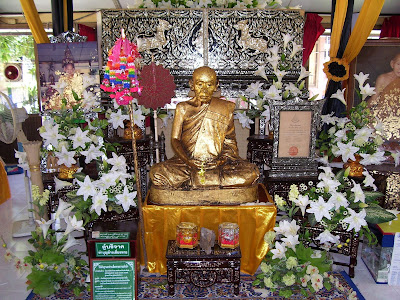
The Shrine to LP (Ajarn) Kong built in 2525 BE (1982). He passed away many yrs ago, but LP Kong used to be one of the most famous monks of this province, skilled in the Puttakom arts of Wat Kao Or.

Inside the shrine we see 3 bronze statues of LP Kong.

The main Chedi of Wat Bansuan, housing the Buddha's relics.

A curious giraffe guardian of this temple.

Another view of the chedi. Some renovations were going on then.

Interestingly, in Thai temple architecture, they always build Nagas to protect the sides of any stair structures.

Behind the chedi are the statues of the 7-day Buddha, one for each day of the week. They depict the Buddha's activities in the 7 weeks following his enlightenment.

A 7-inch (full height 10 inches) bronze bucha of Phra Buddha Maha Mongkon I obtained from Wat Bansuan. It is modelled after the Chiang Saen style Phra Buddha Sihing of Nakhon Si Thammarat. From there let us proceed to the other temples.

Wednesday, July 25, 2007

Phra Malai & Ksitigarbha

"Bitter are the sins of sentient beings,
(they) cannot be exhausted even after 1,000 kalpas;
when the bloodshed flow into rivers,
know that these are fruits of evil karma."

- Songs from Hell

I was reading LP Jarun's "The Law of Karma - Dhamma Practice" Book I the other day and came across an interesting anecdote. In the story of "The Lady with 2 Bodies", the main character Sa-ing recounted how she created evil karma through her misdeeds & how she fell into Hell to suffer for 100 yrs. She mentioned that on observance days a monk (Phra Malai) would come to teach the hell-beings. In Hell they made the hell-beings chant & pay homage to the Triple Gems. Sa-ing had never chanted before in the human world, but after being in Hell she could recite all the Kathas fluently. Phra Malai was there to teach them about Karma. He also taught that in Hell they had to chant & practice Vipassana meditation just like in the human world.

Who is this Phra Malai, teacher of the hell-beings? Legend has it that he is an Arahant from Sri Lanka, who achieved great supernormal powers through his own merits & meditation. He is also honoured as a successor to Ven Mogallana, the Buddha's disciple foremost for his supernormal attainments. The story of Phra Malai is well-known throughout Southeast Asia, especially in Thailand & Laos. In the story this pious and compassionate monk descends to Hell to give teach & comfort the suffering hell-beings there. He also learns how the hell-beings are punished according to their sins in the different hells.After returning to Earth he is presented a bunch of lotuses collected by a poor man, who wished to be freed from poverty. Phra Malai ascends to the Tavatimsa Heaven to pay homage and offer the lotuses to the Culamani Stupa, which enshrined the hair that the Bodhisatta cut off after renouncing his princely life in his father’s palace centuries ago. In this heaven, Phra Malai & Indra, King of Tavatimsa, converse on how merit is accumulated. Phra Malai eventually has the chance to meet Maitreya, the future Buddha. Maitreya gives him instructions for the people on Earth on how they may progress spiritually, make merit, and benefit further from his teaching when he eventually comes to Earth for his last existence, during which he will achieve Buddhahood. Phra Malai later returned to the human world and preached widely about Heaven & Hell, as well as Maitreya's instructions to the faithful.
The interesting thing is that even though Phra Malai had entered Parinibbana for more than 2,000 yrs ago, he continues to manifest himself in the hell realms to help the beings there. The true story of Sa-ing took place in the late 1950s. Without Phra Malai's teachings, Sa-ing would not have been able to free herself from Hell. She would probably still be suffering there till this day. Sa-ing and countless other hell-beings taught by Phra Malai throughout the centuries owe their teacher a great debt.

The deeds of Phra Malai bear striking similarities to Bodhisattva Ksitigarbha, his equivalent in Mahayana Buddhism. Perhaps they are one & the same enlightened being? Ksitigarbha is not just the Teacher of the Hell realms, but he is also the guardian of all beings in our Jambudiva world in the long time between Buddha Shakyamuni's parinirvana and Buddha Maitreya's appearance into this world. Just as Phra Malai is a Savaka Arahant, Ksitigarbha also manifests himself as a Savaka instead of a Bodhisattva to teach others. Thus he is always potrayed as a Bhikku monk rather than in Deva form like other Bodhisattvas.
Like Phra Malai, Ksitigarbha also appear in the hells on observance days to give Dana & teachings on Karma to all the hell-beings. If any of these beings seeing or hearing the Bodhisattva sincerely repent their past misdeeds, they would be liberated from their suffering through the power of the Bodhisattva's merits. Such is the great compassion shown by the Teachers of Hell.
Whether it is Phra Malai in Theravada or Ksitigarbha in Mahayana Buddhism, they teach us that no matter how much evil a person has done, such that he or she has fallen into the various hells of their own making, all it takes is a single thought of true repentance & the forsaking of past evil to be liberated. Of course, one still have to expiate one's own negative karma over time, but as long as one does not create any more new karma, the old karma will eventually be exhausted & one will be able to ride on the highway to Buddhahood without any obstacles.

Saturday, July 14, 2007

The Truth of Avici Hell

The Parinirvana Sutra says:

"Among the 8 great Hells, the worst is known as Avici Hell. Because one experiences immense suffering without any interval, thus it is given such a name."

The Ksitigarbha Sutra says:

"Avici Hells are hells reinforced with iron surrounded by iron walls, 8 millions miles wide and 1 million miles high. These Hells are fully filled with burning flames and are jointly linked up together with other Hells of different names. Among them there is one Hell by the name of Avici. The area of this Avici Hell is eight thousand square miles. The whole of this Hell, with iron walls, is packed with burning flames. Iron snakes and dogs with hot fire in this Hell run from the East to the West. Also, there is an iron bed and when one is cast there, he can see his own body filling it. Therefore, all beings are subjected to punishment according to their sins."

In Buddhist cosmology, Avici Hell is considered the worst and most severe of all the hell realms in existence. The Sanskrit term "Avici" means without interval, referring to the unceasing torments that sinners in that hell experience for an unimaginably long time. What type of beings get reborn into such a terrible place? Those who have committed any of the 5 heinous sins, namely:
1. Murdering one's father
2. Murdering one's mother
3. Killing an Arahant
4. Shedding the blood of a Buddha
5. Creating discord within the Sangha


Which brings us to a young Canadian girl in the news, Jasmine Richardson, charged with ganging up with her boyfriend to murder her parents and little brother in 2006. The 12 yr old Jasmine became the youngest person ever charged with a multiple murder in Canadian history. The reason for the senseless killings is due to her parents disallowing her from seeing her 23 yr old boyfriend Jeremy Steinke. She was angry at being grounded, and after seeking help from Jeremy, they hatched a plan to kill all the people obstructing their paedophilic relationship. They eventually succeeded in murdering the rest of Jasmine's family members, although it was Jeremy who carried out most of the killing. The only thing Jasmine did was to "stab her little brother". Jeremy finished off the job by slitting the boy's throat. Nevertheless, on July 9th 2007, Jasmine was found guilty of three counts of first-degree murder in the killings. She would be sentenced to a maximum of 6 years imprisonment and 4 years of probation, which is the maximum penalty for a person under 14 years of age next month (August). As for Jeremy, his trial would probably start only next year, and according to Canadian laws, he would be sentenced to life imprisonment if found guilty of the murders.

Despite the vivid descriptions in the scriptures, Avici Hell is not so much as a place that people who have done great evil go to after they die, but it is right there in their very minds. In Jasmine's case, the moment the thought of hatred arose in her mind towards her parents, the pit of Avici Hell had already opened wide for her to fall into. One thought leads to another, which is no different from her falling deeper and deeper into Hell. When the thoughts transform into action, she had already landed on the burning iron bed inside Avici Hell. The torment began right then. Now, after being arrested, charged and sentenced by a worldly court, it is not life in prison that would bring her the greatest suffering, but the mental guilt that would plague her every single day for the rest of her life. That is truly a long lasting suffering that is Avici, without interval. And we all know where all that guilt is going to take her mind-stream upon the dissolution of her body.

More fearsome than any weapon on Earth, is the thought of hatred. Consuming everything in its path, it would not be extinguished until both subject and object are plunged into great suffering. Endless is the sea of suffering, yet simply turn around and the shore is right before you. Will the young Jasmine ever have the chance to turn around? Let us pray that her dead parents and brother will one day forgive her for her sins.

Sunday, July 01, 2007

Query on the authenticity of the Tooth Relic

An Arabian proverb says:

"It doesn't really matter what you worship; what matters is how devoted you are."

A Buddhist culture researcher named Ye Guofeng wrote a letter to Zaobao paper's forum page on Friday (29.6.2007), questioning whether the Buddha Tooth Relic kept by the Tooth Relic Temple in Chinatown is real. His letter in Chinese could be read here:
http://www.zaobao.com/yl/yl070629_502.html

In the letter Ye calls for DNA testing to be done to the tooth, or for a dentist to examine whether it is a human tooth at all, given its large size. He also demands verification by scriptural references to the existence of such a relic. Ye says that in the past many so called tooth relics in other parts of the world were discovered to be fake, so Singaporeans should have a right to know whether what they are venerating is authentic. After all, local people donated more than 43 million dollars & 273kg of gold to construct the temple as well as the gold stupa to house the tooth relic.

I believe the abbot of the temple ,Ven Fazhao will have to make a public clarification soon since somebody had already raised such a doubt on the tooth relic. Personally though, it makes no difference to me as I'm neither an archaeologist nor an academic. There is a well known Tibetan tale on the meaning of authenticity:

A poor old woman living in a small village in Tibet saved all her life to buy a relic of the Buddha. Hearing that one of the Buddha's tooth relic was going to be sold in a city in neighbouring India, she gave all the money to her no-good drunkard of a son and told him to travel there on a pilgrimage to obtain the relic for her. But he soon got distracted by the sights and sounds, squandering all the money on alcohol and girls instead. Later on the way back he found a dead dog in the gutter & took a tooth from its mouth. Wrapping it in a piece of golden cloth, he decided to bring it back to his mother in Tibet. The son even derided her for her superstitious faith as he presented her with the fake tooth relic. A week later, he passed her room and saw her praying before her little altar. The mouldy dog’s tooth was ablaze with divine light, and soon the whole village learned of the amazing occurrence. His mother's little altar had transformed into a famous shrine of the Buddha's relic overnight! Many miracles were attributed to it and to his mother as keeper of Buddha’s tooth. Her deeds of compassion and goodness were profound and her happiness unbounded. The young man, however, grew more and more disturbed as the relic’s reputation grew and his mother’s saintliness increased. This built up over years, and finally he couldn't stand living a lie any more. One evening, after several Lamas had visited and received both blessings and teachings from the tooth, he finally blurted out the true story to his mother: “That's not the Buddha’s tooth. I lost all the money you gave me. I got that tooth from a dead dog!" And he ran outside the house. Just outside the door stood a magnificent man looking at him with eyes of loving-kindness. It was the Buddha. In a gentle voice, the Buddha said: “That was my tooth, you know."

So there you have it; faith or science? It is all up to you really.

Saturday, June 09, 2007

Travels in Pattani - Wat Saikow & Wat Si Mahapo

After leaving Wat Changhai, I went to Wat Saikow, which was only a few kilometres away. This is the temple where Ajarn Nong was abbot for many years. Ajarn Nong & Ajarn Tim of Wat Changhai were the first 2 masters to create LP Tuad amulets, for they were Sangha brothers who became equally famous for popularizing LP Tuad's protective power. Both masters have since passed away.
The temple gate. Compared to Wat Changhai, Wat Saikow is virtually deserted save for the current abbot and a few lay helpers hanging around. I heard most of the monks left to avoid the violence in this region. So there were no soldiers to guard this temple & most of the temple buildings were closed also.
The Wihan (Vihara), closed to public.

Shrine to LP Tuad, which was opened luckily.

Inside the shrine room, which venerates LP Tuad, Ajarn Nong & Ajarn Tim.

Inside the main Sala.

The beautiful Bot, which was also closed. As there was nothing much to see, I went to see the abbot to get some amulets from him before making a move.

Next I went to Wat Si Mahapo, which was slightly further away. I had originally intended to go to Wat Sampowchey to see LP Thong, but the driver informed me that he was in Bangkok to avoid trouble as well. So I changed my mind & decided to go to Mahapo instead. This is the temple of LP Daeng, a master also famous for making LP Tuad amulets like LP Thong. But he had passed away years ago whereas LP Thong is still around. There were quite a lot of people in this temple and thus a squad of soldiers was there to protect them as well. The soldiers smiled at me while I toured around; I think they had probably had not seen tourists for a long time. Above is the temple's Bodhi Tree.

The standing statue of LP Daeng, the past abbot of Wat Si Mahapo.

The statue of LP Tuad riding on a ship & performing a miracle with his foot. This is the kind of LP Tuad image that Wat Si Mahapo is well-known for. Behind is the shrine to LP Daeng as well as the temple counter.

A Sala with a royal Buddha statue inside, known as LP Ong Dam. Thought I saw this kind of image before elsewhere.

Shrine to LP Tuad.

A banner advertising the release of LP Wan buchas. LP Wan is from Wat Sabah Yoi in Songkhla. Can't say I know who he is or what he is well-known for.

The Bot was closed.

Inside the main Sala where many students were having their lunch under instruction from the monks on how to eat with mindfulness. Guess this must be a religious camp for them.

Inside the LP Daeng shrine, where we see his seated golden statue. Behind the altar is LP Daeng's casket. The driver told me LP Daeng's body was also undecaying like LP Tong of Wat Pagor, but I can't really tell since they did not use a glass casket like in LP Tong's case. After praying to LP Daeng, I approached the temple counter at the side to obtain some souvenirs. The amulets here are quite cheap & the helpers quite friendly. A Luang Pee (Venerable Brother) at the counter even gave me & the driver free amulets! This left me a good impression of the temple. With that, we made our way back to Hadyai.

Thursday, June 07, 2007

Travels in Pattani - Wat Changhai

On 21st May 2007 I travelled to Pattani province from Hadyai. As we know it is one of the hotbeds of terrorist attacks at this time. But I was determined to go pray at the temples devoted to LP Tuad, the most respected Bodhisattva monk in Thailand, despite the threat. One can feel the tension as along the way there were many road blocks & soldiers inspecting passing vehicles. My first stop was at the famous Wat Changhai, the place where LP Tuad entered Parinibbana. "Chang" means elephant & "hai" means given. That's why we see a lot of elephants at this temple. Above is the entrance & not far outside is the railway. You can read more about the legend of LP Tuad at: http://geocities.com/thai_pendants/legendary_lp_thuat.htm

Statues of an elephant & its mahout guarding the entrance. There were also many armed soldiers guarding the temple.
The temple's Wihan (Vihara).
This is the closeup view of the sacred LP Tuad golden statue inside the Wihan.
A more complete view of the statue & altar.
Other smaller statues at the side of the Wihan. Young girls are pasting gold leaf onto the statues.
Another slightly bigger LP Tuad statue in the Wihan, flanked by elephants.

This one is riding on an elephant.
Asked my driver to take this shot behind the Sala.

The altar inside the Sala. A reclining Buddha lies across it.
The Chedi-shaped shrine beside the railway.
Another golden statue of LP Tuad is venerated inside the shrine.
The main Chedi of Wat Changhai. Inside the chedi are the holy relics of LP Tuad. But it is closed to the public most of the time.
Inside the Bot. An ordination ceremony fro 6 guys was taking place at the time. When will I get my chance to ordain? Ajarn Tim, past abbot of Wat Changhai & the first master ever to make LP Tuad amulets. After getting some souvenirs from the temple counter, I proceeded to my next destination, Wat Saikow.

Saturday, June 02, 2007

Why do we prostrate?

Buddhists prostrate themselves everyday before the Triple Gems, whether it is to pray, to chant sutras, before they meditate etc. What is the purpose of such practice? Is is only for showing respect to holy people & objects, to venerate or even worship them? Or is there a deeper meaning to it?

The Noble Ones taught us that it is not the outward show of veneration that matters, but the conquest of ego & pride within your own mind that is really important. We do not prostrate ourselves out of fear or to beg for favours; we do it for the wisdom that arises from the weakening of attachment to a Self.

However, some people who studied the Mahayana teachings of emptiness come to the conclusion that most of the traditional Buddhist practices, including prostration, are meaningless outward rituals & should thus be abandoned. They fail to appreciate the teachings that these practices symbolize & how they benefit the mind. This is a mistake. One would think that the enlightened ones no longer need to follow such rituals, but the truth is not like that. There is a very interesting Koan to illustrate this point.

Once a young novice saw Huang Bo prostrating in front of a Buddha statue at a monastery. So he asked the master:
"Not to cling to the Buddha, not to cling to the Dharma, not to cling to the Sangha; may I know what is the master praying to?"
"Praying to such teachings of non-clinging" was the reply.
"So why are you still prostrating?" the novice pressed.
At this, Huang Bo gave the novice one tight slap!
Reeling from the pain, the novice exclaimed, "How can you be so rough?!"
"What place is this, such that you complain about roughness & fineness?"
The novice had an awakening at that moment.

Contemplate on "what place is this" & you may see the answer for yourself. Then you will automatically bow to the Triple Gems daily without anybody telling you to!