Tuesday, February 01, 2011

Questions & Answers on the Netherworld IV

The following is an interview of Mr Li Shu by his good friend Lin You Xiang. It is called "幽冥问答录" in Chinese. Mr Li had worked as a Judge in the Netherworld in the beginning of the previous century, and wished to share his experiences with his close friends. This interview was written down many decades ago and gives a very detailed, first-hand account of life in the ghost realm.

Q61: In the netherworld are there cultivators who recite Amitabha? If reciting and chanting Sutras have such great merit, why don't all the ghosts quickly practice so as to be liberated from their state of woe? If they don't know how to chant, why don't they learn from the human world?

A: Once a person enters the netherworld, his mind will be blocked by his own negative karma; as such he won't know how to do recitation or chanting. Even if we humans recite and chant, they also won't be able to see or hear us. That's why if we want to cultivate, we must do it while we are still alive. Once we die and go to the netherworld, it will be very difficult to do it.*

Q62: Since ghosts can see and hear what is invisible and inaudible to humans, then how come they cannot see or hear us reciting or chanting?

A: As I said, this is due to their own karmic obstacles. Look at the people in this world - some are without religion, some are oppressed by cold and hunger; they too cannot hear us reciting or chanting. Even if they do hear us by chance, they will be too caught up with their own desires, disbelief or lack of will. So at the end of the day, they also won't cultivate or chant; how are they any different from those ghosts who can't see or hear?

*However on Uposatha days, the Teachers of the Netherworld like Phra Malai and Ksitigarbha Bodhisattva will appear to the ghosts, and through their supernormal power, these beings will be able to hear the sacred verses and learn to chant. But this only applies to those ghosts whose negative karma are not very severe.*

Q63: How do the voices of ghosts sound like?

A: They sound sharp and short-breathed.

Q64: From the perspective of the ghosts, humans and ghosts are living mixed with one another. But from the perspective of humans, both worlds are separate and distinct. How do we really define the borders of both worlds?

A: That appears to be a border, yet it cannot be clearly defined. The exact situation is very difficult to be explained with words.

Q65: The spirits of the living and the ghosts of the dead - are they different in form?

A: I have not paid much attention to that. But of course there is a slight difference.

Q66: How does it feel to be a ghost?

A: They feel that they are suffering a lot. Thus what they talk about is mostly sad and tragic stuff.

Q67: When the ghosts are send for rebirth, does the Lord of the Netherworld admonish them to give up evil and cultivate what is good?

A: No. Except for those destined to be reborn as animals. Those ghosts won't know where they are heading, and the womb or egg will be made to appear like attractive men or women, palaces or pavilions so that they will be happy to enter it.

Q68: When the sky is clear and the sun and moon are shining brightly, how come their light won't reach the netherworld? Is there something blocking out the light? If the human world is separate from the netherworld, then how can humans and ghosts walk side by side?

A: Because the netherworld is always covered by clouds and fog, sun and moon light cannot shine on it. But ghosts can roam freely in the dark regions of the human world, especially at night. That's why they can walk side by side with humans.

Q69: What calendar is used in the netherworld? Are all the official documents dated?

A: During the Qing dynasty, we used the Qing calendar (xx year of Emperor so-and-so's reign etc). Basically no different from the human world.

Q70: If humans are reborn from ghosts, then what are the children of ghosts marriages reborn from?

A: They are reborn from the residual Chi (energy) left over after people die.

Q71: Can the ghost children be reborn as humans when they grow up?

A: They can't.*

*Ghost children possess no independent sentience apart from their ghost parents - they are like muppets or robots. That's why they cannot be reborn into other realms.*

Q72: Is there bad weather in the netherworld like wind, rain, hail and snow?

A: Didn't see any, but whenever there is such weather in the human world, the ghosts will somehow also suffer from the cold, coiling up and shivering in great unease.

Q73: Are there social gatherings for ghosts like marriages, birthdays and funerals etc?

A: Yes, no different from the human world.

Q74: What are the uses for joss sticks and candles during offerings?

A: Candles provide ghosts with light, and joss sticks are for summoning them with the smell.

Q75: What about fire crackers?

A: Ghosts are afraid of the exploding noise, so it is no advisable to use them.

Q76: Chanting Buddhist Sutras produce great merit, then what about Confucian texts?

A: They have merit too.

Q77: The guardian deity of Buddhism is Weituo, and for Taoism is Wang Ling Guan. Does Confucianism have any guardian deity?

A: No, because Confucianism is not established from the belief in gods. However their classics are also protected by good deities, no doubt about it.

Q78: Where do the salaries of netherworld officials come from? Do they collect taxes of money and grain as well?

A: I once asked my colleagues about that, but they told me not to ask. Thus I also have no idea.*

*All those hell bank notes and paper money burned in the human world end up in the netherworld government treasury.*

Q79: The light rays emitting from human heads; which are good and which evil?

A: Red, white and yellow come from good people and black comes from evil people.

Q80: Ghosts are reborn from humans, and humans from ghosts. So which came first in this world, human or ghost?

A: There are 2 aspects to look at this. In the far ancient times when heaven and earth have just separated, and where the atmosphere of innocence still prevailed, naturally there were humans first before the ghosts. But in the later eras when humans become more corrupt, ghosts come before the humans.

Q81: Do ghosts miss their previous spouses and kids in the human world?

A: Quite a lot. But as time goes by, they will slowly forget them.

*This is the final installment of this series.*

- The End -

Tuesday, January 25, 2011

Thoughts after watching "Hereafter"


Ah.. a Hollywood movie about the mystery of the afterlife and the in-between. While the interlinked stories are interesting, this movie does not try to provide any answers. All 3 main characters still remain in the dark as to what the next world is like. But by the end of the movie, they have found new meanings in their lives to continue on.

What this movie really reveals is that 99% of the world is still in ignorance about the nature of death. Despite the great advances that modern man has made in science and technology, yet he is no more knowledgeable about his own mortality than men in ancient times. Which is strange, since none of us can escape the final destination. One would think that something so pressing should deserve much more attention then it is getting. However we are always so lost in the pursuit of our own desires that we either try to sweep it under the carpet, or conveniently subscribe to long existing wrong views about it. 99% of people fall into the pits of either eternalism or nihilism. Those with religion will believe that their souls live forever and those without will believe that there is nothing after death. Even among so called Buddhists, it is hard to find people with "Right View". Verily, finding one with right view is as rare as finding a needle in a haystack.

So what is the right view? Not to subscribe to these 2 kinds of wrong view is the right view. Not to subscribe to any kind of duality is the beginning of true seeing. Thus the scriptures say, "Without views one maintains the right view". It is not the same as indecisively sitting on the fence, but a conviction born from understanding the nature of emptiness. Although we think we are born and die, but what is born and die is not really us. Because in the great void nothing ever comes into existence or ceases to exists. Like movie characters dying on the screen; have they really died? The world is no different from a movie screen, and what we believe we are are in reality only projections of our own deluded mind. When the mind stop projecting, then only can one see that there is only a blank screen, and that the mind is no different from the screen; the mind IS the screen. But just in case you start to cling to that as the truth, the mind is also not the screen. If you realize something here, just see it silently is enough; do not cling to any concepts at all, otherwise King Yama is not going to let you off when you step into the "hereafter".

Sunday, January 23, 2011

LP Boon Ler of Wat Kam Yard

LP Boon Ler of Wat Kam Yard in Ang Thong is a well-known Bodhisatta monk and a great healer cultivating the 10 Paramis. However when I went there LP was away in Bangkok.
The old Ubosot of the temple, where takruts mystically "flew" down from the roof top after one of the male devotees made a wish to see the power of the Buddha statue inside.
The LP Tuad and Somdej Toh shrine beside the old Ubosot.
The "flying takrut", which lay women at the temple said had powerful protective powers - one of them had a son who wore it and met a serious traffic accident where the car was completely wrecked, but the guy was miraculously unharmed.
An old tree in the middle of the courtyard.
The bell tower.
Statue of King Thaksin riding his horse into battle. This temple had some historical link to the great king.
The Chedi where mystical Biagae with healing and poison absorbing qualities were excavated.
The Sala of the Reclining Buddha.
Stairs leading up to the Chedi.
The Monday Buddha (Pang Ham Samut) statue inside the Chedi.
Signboard mentioning about the consecration of a new batch of King Thaksin amulets.

Monday, January 03, 2011

Visit to Wat Panom Yong

Wat Panom Yong in Ayuttaya is the temple of LP Jamlong, the famous wicha master. He is not the same as LP Chamlong of Wat Chedi Daeng, as some might get confused. Above is the temple gate.
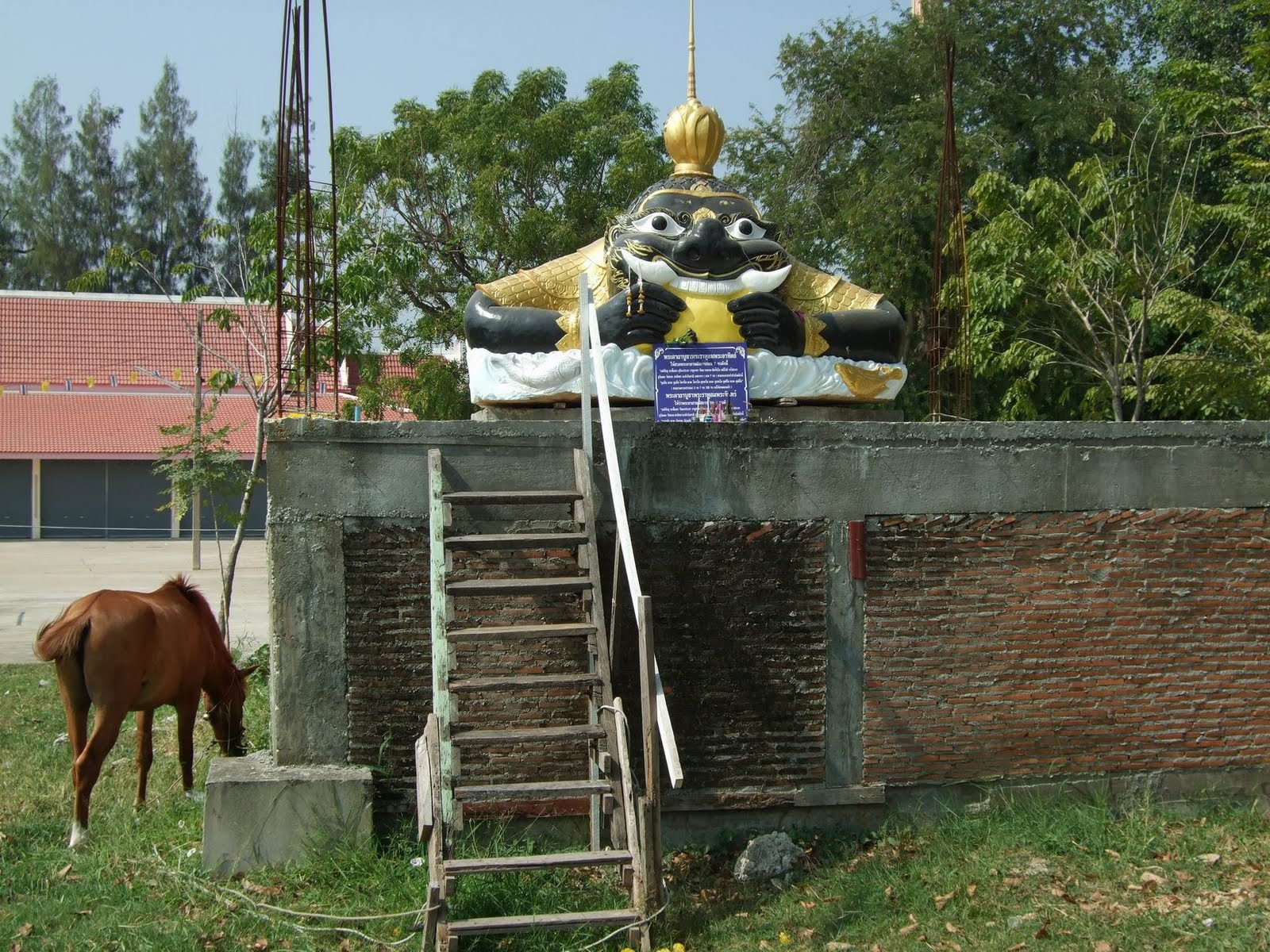
The yet to be completed Phra Rahu Shrine.
A cute pony beside the shrine. It is quite tame.
A big poster indicating the number of masters who will come to consecrate the Rahu shrine.
The Chuchok shrine. LP Jamlong is an expert in the Chuchok spell.
The temple counter.
The Ubosot.
Outer gate of the Ubosot.
The altar to the presiding Buddha image of the temple.
Having a shot taken with LP Jamlong, who kindly explained to me how to use some of his amulets.
The "Takrut Kor Mah" (Dog Neck Charms) or Maha Amnaj Takruts that I chowed from the temple.
The famous Luang Por Chao Noi Buddha Shrine outside the temple.
Katha to worship Luang Por Chao Noi.
LP blessing the bag of Phakod that I have chowed.
The Phakod Peun Kram Bon Yan.

Friday, December 31, 2010

The Legend of LP Jamlong

“My name is Long, Long with an L not an R, as Rong means always the second best, I am Jamlong and I will not be second to anyone.” That's what LP Jamlong used to say last time. He is a real adept monk from the old capital and this is certainly not a boast. LP's brief history goes like this - before he joined the Sangha he was a ‘Li-ke Guru’ (Li-ke is traditional Thai opera), and he also knew the ‘Chuchok Spell’ (Chuchok is a beggar king). Other Li-ke bands have to ask people for work, but for his band it was the other way round as they received so many invitations all the time. As long as he used the Chuchok Spell, all the money and necessities of life will keep coming to him without much effort.

Later he got tired of living in the superficial society, so he ordained and went to studied with LP Er of Wat Panomyong. LP Er is the one who taught Thailand’s statesman, Mr. Preedee Panomyong (he was also the one who advised Mr. Preedee to use the last name of Panomyong, after the name of the temple instead using his Chinese family name). After that LP went to practice with LP Pan of Wat Pad Ar. From there he learned to make the ‘Phakod’ (sacred knotted cloth) or ‘Bullet Proof – Gambling House Afraid – Magical Knotted Cloth’. His first try was done by using ‘Bungsukun’ cloth (a yellow robe placed on the coffin before lighting the pyre for performing a requiem by the monks). He tested the cloth by throwing it to the fire, and somehow it won’t burn. I know it sound ridiculous but if you don’t believe it, you can underline this paragraph and go to ask LP himself whether this is true or not.

At one time when LP Tim of Wat Phra Khao was still healthy, some villagers from Ang Thong Province came to worship Luang Por Chao Noi (the famous Buddha statue) of Wat Panomyong. They then paid a visit to LP Tim and asked him for some sacred objects with power for doing business. When LP Tim learned that they had already passed Wat Panomyong, he told them, “You have missed a real deal there; isn’t LP Jamlong there at Wat Panomyong? Why don’t you ask such things from him? He is quite an adept monk.” LP Than Chaokhun Sawat of Wat Salapoon also praised LP Jamlong as ‘one with very powerful mental force’. His Metta was really more intense than LP Sawat when he was younger. These testimonies guarantee that LP Jamlong is one of the most adept Wicha monks in Ayuttaya.

One day LP had a strong inspiration, so he took out some copper foils, rolled them up and bound them with twined rope. He then coated them with black lacquer before tying them around the neck of his dogs. The villagers and his disciples called it ‘Takrut Kor Mah Ayuttaya’ (Dog Neck Charms of Ayuttaya). Those dogs who wore the Maha Amnaj takruts were typical local Thai dogs. One of them dog had a fight with a foreign dog the size of a man. And the result? This Thai dog won without any scratches and the foreign dog had to run for its life. ‘Tam’ was another one of those dogs that wore his takruts. It took a nap at the Sala of the Sleeping Buddha which is situated at the temple’s frontage. Some villagers brought food to make a votive offering to the Sleeping Buddha and also wanted to light some firecrackers. To their surprise, the firecrackers won’t burn at all; they just keep extinguishing. Finally someone realized what's happening and bent down to see Tam lying under the table. They knew right then that it was Wat Panomyong’s dog and had to drive him off. This time those firecrackers burn normally and exploded loudly as they should. Another story was told that some naughty kids used a handmade muzzle-loading gun to shoot the dog but it also won’t fire. Miraculous, right?

Tuesday, December 28, 2010

LP Chom of Wat Klang Khun Paen

LP Chom of Wat Klang Khun Paen, Ayuttaya is the successor of the great master of Metta magic LP Sawai Wat Preedaram. I decided to visit this LP to check out his stuff. Above is the Mai Takian shrine at the temple.
The giant gong.
Devotees praying inside the Ubosot.
Front gate.
Side view of the Ubosot.
The main altar inside LP's kuti. Many Lersi buchas. Notice the giant Khun Paen on the left!
Photos of LP visiting devotees in Hong Kong.
LP drawing Yants on my Khun Paen amulets.
LP inscribing Yants onto my Chuchok bucha.
Photo with LP Chom. He is getting more and more popular overseas.
My Chuchok bucha.. it looks "live".
Having LP perform a Nanathong gold foil blessing on my forehead on my 2nd trip there.
Closer view.
LP blessing the small tiger palakits that I chowed.
Blessing the big tiger palakit bucha.
Applying Metta oil.
Blessing completed.

Saturday, December 25, 2010

Good Children Bad Children

During the Qing dynasty era there was a rich man in Zhejiang province named Wang Weng, who had inherited much wealth from his ancestors. Wang married at 20 yrs old and in the 10 over years that followed, he had 9 children with his wife. However all these 9 children were retarded or of low intelligence. Despite their condition the parents still loved them very much.

In the reign of Emperor Qianlong, there was a severe famine and many people died of starvation. At this important time, Wang sold all his property and used the money to help with disaster relief in his hometown. Many lives were saved as a result of his generosity. Everyone who had received aid were very grateful and regarded Wang as a living Bodhisattva. What they did not know was that both Wang and his wife were strong devotees of Bodhisattva Guanyin. That was why they were able to perform Dana so readily, without any hint of stinginess. Dana is the foremost of the 6 Paramitas and Wang had indeed followed the Buddhist teachings wholeheartedly.

What happened after that brought a big shock to many people; Wang's eldest son contracted an acute disease and died soon after. In the space of a few years, the rest of his 9 children fell sick and died one after another! Everyone was puzzled and thought, "Wang and his wife made such a big merit by selling all their property to save so many lives; why did they not reap any good fruits for their good karma? Maybe their belief in Guanyin is not efficacious at all?" And there were also the foolish who thought, "Do good deeds and you get evil results. That proves there is no point doing good at all. Better for me to do what I want!"

Wang and wife were of course deeply saddened by their children's deaths, but due to their strong faith in Guanyin, they did not give up their belief even after what happened. They continued to pray to Guanyin everyday without fail. One day they wrote a proclaimation and burnt it in front of their Guanyin bucha to express their pain.

That night Guanyin appeared in Wang's dream and told him, "Good man, do not be sad. The 9 children you had previously were 9 demons, sent by the Heavenly Emperor into your family. As a result of hidden evil karma created by your ancestors, these 9 demons manifest as your 9 bad children to squander away all the wealth that they have accumulated. But due to the great merit that you have made by selling your properties to relief the great famine, he had decided to recall the 9 demons back. Not long after this the Scholarly Star will descend into your family. You have a bright future ahead, therefore rejoice!"

Wang woke up the next morning and told his wife what he dreamt about. To his surprise, his wife said she dreamt of the exact same thing! From then on the couple no longer felt sad and were inspired to continue helping those in need. Soon after Wang's wife conceived again and in the years that followed she successfully gave birth to another 5 children. All these 5 children were very intelligent, had excellent memory and were well-learned in all things. One of them was Wang Wenjian, who became the top scholar of the empire and eventually promoted to a Minister in the imperial court. Even up till today, Wang's descendants continued to be very prominent in their achievements.

This is a true story. The moral of the story is: Do not be happy if you have children; for they may well be your debtors from previous lives coming to claim what you owed them in the past. Do not be sad if your children die also, for they may just be leaving after claiming back the full debt from you. Or they may be your creditors, who will also leave once they have repaid what they owed you previously in full. Most of the time smart children who do their parents proud but die in their prime are such creditors. Complex as karma is, the intricate connections between close relatives can basically be summed up with 3 words - Debtors and Creditors. That's why those who can gain insight into the emptiness of worldly life and relationships will be able to remain calm no matter what happens.

Wednesday, November 24, 2010

Ming Yi reinstated as Abbot

On Monday (22.11.10) there was an article on how the Foo Hai monastery held a grand ceremony recently to reinstate Ming Yi as their abbot, and also to commemorate his 20th year as the leader of that temple. This was followed by a big dinner at Pan Pacific Hotel. Most of the Buddhist community in Singapore felt this was very inappropriate as he had just been released from jail. Instead of keeping a low profile to repent on his moral errors, here the monastery is ironically putting him up on a pedestal once again.

Upasaka Li Muyuan, chairman of the Buddhist lodge rightly criticised that such behaviour was "an exaggeration" and unprecedented in the history of Buddhism. None the great masters of the past ever promoted themselves like that. In the Nirvana Sutra, the Buddha said,

"After I enter Nirvana, you should rely on the 4 Dharmas as your teacher."

What are the 4? Namely:
1) To rely on the doctrine and not the person
2) To rely on insight and not on knowledge
3) To rely on the meaning and not the words
4) To rely on the transcendal meaning and not the conventional meaning
I
The wise know thoroughly the danger of feeding the ego and thus avoid such ceremonies which serve no purpose at all. Instead of relying on the good doctrine as their teacher, the fans and followers of Ming Yi continue to rely on him for "guidance". He cannot even guide himself.. how can he guide others? It is pitiful indeed, that Ming Yi makes one mistake after another, which will compel him to embark on a path of no return. He is not worthy of the Sangha robe that he clings so dearly to.

Thursday, November 18, 2010

Questions & Answers on the Netherworld III

The following is an interview of Mr Li Shu by his good friend Lin You Xiang. It is called "幽冥问答录" in Chinese. Mr Li had worked as a Judge in the Netherworld in the beginning of the previous century, and wished to share his experiences with his close friends. This interview was written down many decades ago and gives a very detailed, first-hand account of life in the ghost realm.

Q41: Between ghosts and humans, whose numbers are greater? Humans are afraid of ghosts, are ghosts also afraid of humans?

A: The number of ghosts in the netherworld are more than humans. Coming and going, here, there and everywhere. Humans walk in the middle of a path, ghosts walk at the sides. Humans like to walk in the light, ghosts like to walk in the dark. Ghosts are also afraid of humans; they usually move away when they see humans approaching. If the person is a righteous gentleman, ghosts will also respect him. Those people harassed by ghosts are usually of crooked character or down on luck. As such from the afternoon till the night, try to avoid walking at the sides of a path or where it is dark. When going out at night, don't walk so fast or cough a few times to let the ghosts know you are approaching. If you accidentally bump into them, you will feel a sudden chill. When Yin and Yang energy clash, both will feel uncomfortable as a result.

Q42: Is there a difference in how ghosts walk as compared to humans?

A: The feet of ghosts can't be clearly seen. It is as if they were walking in smoke. They move much faster than humans.

Q43: Why are ghosts afraid of roosters crowing?

A: Because that means that sunlight is coming soon and they have to hide. This is similar to humans avoiding the heat emitting from an oven. However for ghosts who have virtue and merit, they won't be afraid of sunlight.

Q44: Sir, your past karma must be quite exceptional and different from ordinary people. Will you be freed from the wheel of rebirth in the future?

A: It's easier said then done. I cannot avoid it even in my next life. I asked my "colleagues" to check my future destination for me and they told me I will be reborn in the Nanyang district of Henan province. However decades have passed since then and I know not whether there are any changes.

Q45: Do the officials in the netherworld get reborn also?

A: Of course. Like those officers in the civil service who find it easier to switch to a better job than ordinary people due to their positions, the netherworld officials are no different.

Q46: When ghosts head for rebirth, do they enter at the moment of conception or at the moment of child birth?

A: Both scenarios can also happen.*

*If according to the Buddhist scriptures, the consciousness to be reborn is drawn into the new being at the moment of conception.

Q47: Since there are so many ghosts staying indefinitely in the netherworld, why don't they seek to be released from that state ASAP?

A: Because there are more ghosts than humans and thus there is not enough supply to meet the demand. Furthermore the family which the ghost will be reborn into must have some past affinity with each other; otherwise it won't work out. If the ghost had a wide social circle when he was alive, then he would find it much easier to be reborn. But if he was a poor person who remained in his hometown his whole life, knowing very few people, then it would be very difficult. This kind of ghosts would have to wait very long to find a family that may have some affinity with him.

Q48: Of the 3 main (Chinese) religions of Buddhism, Taoism and Confucianism, which is most respected in the netherworld?

A: They respect all 3. However Buddhism is the most revered.

Q49: Buddhists get reborn in the Pure Land, Taoists get reborn in the celestial realms; where do Confucianists go to?

A: Also in the celestial realms. They won't just disappear.

Q50: Why did you give up on being a judge later?

A: I didn't want to do it on the long term, and had asked to resign several times; but they did not approve it everytime. Later I was taught by a colleague to recite the Diamond Sutra. I followed his instruction and after I finished reciting the Sutra for 2,000 times, I was no longer drawn to the netherworld.

Q51: Sir, are you able to see ghosts at normal times?

A: When I was a judge, I could see them all the time, no matter whether my consciousness was with my body or not. I started to see less of them after 1911 and after 1921 I stopped seeing them altogether.

Q52: How were you notified the first time you went to the netherworld?

A: One night I dreamt of a man in ancient attire visiting me and asking whether I could help him with some task. I replied, "What is it that you need me to help you with? I'm afriad I might not be capable enough to do it?" The person said, "As long as you agree, there is nothing you can't do." I did not know why he was here, but seeing that he was sincere and polite, I agreed tentatively. He appeared happy and told me he would come back to fetch me in a few days. Then I woke up and thought it was just a dream, so I did not think much of it. However after 4-5 days the person really came back and said, "Thank you for you cooperation. I have specially prepared a horse carriage to fetch you." I saw the carriage outside the door, so I hopped on. Later we arrived at some magistrate building and there I alighted there. The person brought me inside into a side room. After a while I was asked to preside over a court and pass judgement. A prisoner was brought before me and the jury officers related his case. When they asked me to sentence, I replied that I have never done this before and did not dare to pass judgement haphazardly. The officers said, "As long as you sincerely evaluate the evidence, you can make a decision according to your wish." I thought about it for a while and said, "Ok let's pass such a sentence." The officers agreed and asked me to sign on the judgement book. The prisoner was then taken away and I was taken back home using the same carriage.

Q53: Did your parents know about this then?

A: At first I kept it secret and did not dare tell anyone. But later my parents saw me alone in the reading room quite often and heard me talking to people, thus they gradually know what I was doing. After I became a netherworld judge, sometimes friends from there would come to visit me. However only I could see them and hear them talking. Others could only hear me talking.

Q54: When your ghostly friends came, did you have to prepare food for them?

A: A cup of tea was all the hospitality required.

Q55: Do they have holidays in the netherworld?

A: No different from the human world. During all the traditional festivals like Chinese New Year and Mid-autumn festival, we were given a few days off. However there was no Sunday rest day in the netherworld.

Q56: How come ghosts are able to shape-shift?

A: All ghosts have that ability, but they must be given approval by the netherworld authorities.

Q57: Have you judged any important cases?

A: They were all quite routine. There was hardly any case that was beyond reason. The sins were always obvious and the evidence clear cut. I've not come across complicated and hard to understand cases.

Q58: Have you toured around the netherworld?

A: No.

Q59: Are Ox-head and Horse-face* for real?

A: They are only masks, used to scare those fierce spirits. For those good-natured people they don't use them.

*Netherworld soliders tasked to bring the dead down to the courts to be judged.

Q60: Do animal and bird spirits appear in the same form in the netherworld?

A: They belong to the juristiction of another department. I'm not too sure about it.


To be continued..

Friday, November 05, 2010

Prison of Anger: Death of Darren Ng


The Dhammapada says:

"He whose conduct is very bad,
Is like oak tree choked with ivy;
So does he inflict upon himself,
what enemies would wish for him."

A young boy's life was lost for nothing, all because of a staring incident between 2 groups of youths. Those 4 guys who killed him are themselves charged with murder, their own lives ruined. The root cause for all this violence and tragedy is none other than their own Anger. Anger is their prison, for it binds and burns these kids, reducing them all to ashes in the end. Even the friends of the victim show themselves to be full of anger at the funeral; little do they realize what consequences such behaviour will bring for them in the near future.
Young people today have no education in the Dhamma, and as such they have no control over their base emotions. Unrestrained, these emotions drive them to do all sorts of foolish deeds, leading to their own ruin. If Darren and his friends could suppress their anger and just walk away from the other group's "challenge", it would not have ended up in bloodshed. There is a time to fight and there is a time to just walk away. Those wise in the Dhamma avoid conflict even before it can materialize into action, by shutting one's eyes and ears from external bad influences. Ignorant people think that to walk away from a fight is cowardice, but it takes true courage to overcome your own ego and do the right thing. If we have to fight, it will be for a just cause; to protect the weak and the innocent. Never to support our own egos or out of anger for those who offend us. This is the way of the Dhamma warrior. Hope all the angry young people out there can learn a lesson from this tragedy.