 1. The Shin Min paper on 8.3.2007 reported a strange & interesting tale of a Malay guy named Riandy being haunted by the ghost of a long dead Chinese lady for the past 7 yrs. He & his family had lived in Telok Blangah since 1975, & only shifted away in 1999. Directly opposite their old flat in Telok Blangah is a stretch of forest & among the trees lies the sunken tomb of that Chinese lady, almost completely devoured by the surrounding undergrowth. Of course, the main character in this real life story had no idea of its existence until recently, when it was discovered by the SPI (Singapore Paranormal Investigators), people whom he seeked help from.
Apparently, the haunting started long before Riandy shifted away from Telok Blangah. Even at his old flat he had experienced loads of paranormal activity, like seeing a blurry figure appearing in the house, hearing somebody quarrelling but not being able to see anyone, smelling a foul stench, & even rubbing shoulders with the ghostly figure at times. Despite all these stuff happening, Riandy did nothing about it. The creepy thing was that the paranormal activity continued after he moved to Choa Chu Kang. For the past 7 yrs, on the 13th of every month, around 2-3am in the morning, he would dream of the long haired Chinese lady in white pleading for help in his old house. And everytime he would wake up in cold sweat. So after being haunted for such a long time, he could take it no more & finally summoned enough courage to seek help, which came in the form of the SPI.
After SPI listened to Riandy's story, a team of them followed him back to his old house at Telok Blangah to investigate. To their suprise, they discovered an abandoned Chinese tomb in the forest opposite his old house, being located under a big tree. Apparently the tree had grown right out of the tomb, crushing whoever lies beneath under its roots. The whole tomb had sunken into the earth, & only half of the tombstone could be seen. The inscription on the stone reads: "Madam Xue of the Yang family's tomb 杨门薛氏之墓", but her maiden name was nowhere to be seen. On the right side of the stone they could also see "Daughter - (Yang) Yueniang 月娘" & "Granddaughters - Qingniang 清娘 & Xiniang 溪娘". The 2 granddaughters would not be surnamed Yang if Madam Xue had no son. On the left side of the tomb is a date saying "Auspicious Plum month of the Xin Chou Year 次辛丑梅月吉". This means the 4th lunar month (May to June) of 1961, or maybe even 1901! The date may be the time this lady died, or the time she was born, but the former was more likely. Considering that the ghost appeared to Riandy on the 13th of the month, it might also indicate that was the day she passed away. The poor condition of the tomb also indicates that all her descendants have either died or were no longer in Singapore, leaving the tomb totally uncared for through the decades. That was why the tomb had sunken and a tree was able to grow out of it; this would make Shin Min's search for her descendants all the more difficult. Madam Xue's ghost, being trapped in that place, was not able to move on and be reborn. She probably could not give up her clinging to her previous human life & her bodily remains. Bur oddly, she seemed to have some affinity with this Malay guy Riandy, which explained why she went to him for help when she had nobody else to turn to. But alas, he too knew not how to help her.
After Riandy found the tomb, his monthly dreams of Madam Xue became much clearer than before. Whereas in the past he only saw the side of her face, now she could clearly see her face, her features, her long hair & even the white cheongsam top that she wore! But this only made it so much more disturbing for Riandy.
I don't know how SPI plans to help Riandy, but the wise thing to do now would be to find an auspicious time to exhume whatever remains in the tomb, ask some respected monks to conduct a Buddhist deliverance (超度 chaodu) ceremony for Madam Xue (since she is Chinese) & have the remains cremated. The ashes could then be placed in a temple & a tablet set up in her honour. Having listened to the Dharma & finally having a proper place for her remains, only then would Madam Xue's ghost be able to move on to a better existence. That would also mean the end of Riandy's paramormal woes. Good luck guys!
 2. The follow up report in Shin Min today (16.3.2007) reveals to us more clues on Madam Xue's mystery. Thanks to Taoism researcher Mr Wu Anquan, who explored around the Telok Blangah forest after reading last week's report, the other half of Madam Xue's tombstone had been recovered. According to the inscriptions on this piece of tombstone, the maiden name of Madam Xue is 音娘 Yinniang (full name - 薛音娘 Xue Yinniang). She died in the 27th year of Emperor Guangxu's reign 光绪二十七年, which is 1901, corresponding to the previous deduction. That is almost 106 yrs ago! Apparently, Madam Xue had 2 sons, (Yang) 福烈 Fulie and 福增 Fuzeng, besides daughter Yueniang. She also had 4 other grandsons, 丞仁 Chengren, 丞德 Chengde, 丞杰 Chengjie & 丞英 Chengying, in addition to the 2 granddaughters mentioned above. Now, the paper made a wrong assumption that because Madam Xue was a grandmother, she must have died quite old. They are thinking in the modern context, forgetting the fact that during the Qing dynasty, most women married quite young and it was highly possible to be a grandmother before 40. Since we don't know how she died yet, we cannot conclude that the person whom used to lie in that tomb died an old lady. Is the female ghost that haunted Riandy the same person as this long dead lady? That is something that still awaits verification!
 Mr Wu's research into the history of Telok Blangah hill also tells us that it used to be known as Xieyuan hill 协源山, which had been used as a burial ground for the Yang family from Fujian province since 1882. All those dead people buried there belonged to the Hokkien Yeo clan. It was only until the 1970s that the government decided to take back the land, exhuming all the graves there & have them relocated to Choa Chu Kang cemetary. Could Madam Xue be forgotten at the time? Since then, a forest has grown over the land and some parts of it developed into Telok Blangah park, as we know today.
Considering that Madam Xue died 106 yrs ago, there is little doubt that all 9 children & grandchildren inscribed on the tombstone would also be dead. If there were any great grandchildren alive in Singapore today, they too would be quite old already. The only way to shed some light on who Madam Xue really was or whether her remains were moved to Choa Chu Kang at all, is to look for those great or great great grandchildren of hers. But even then, would these descendents of the Yeo clan which lived in Telok Blangah a century ago know anything about their great or great great grandmother? The oddest thing is that, what does a young Malay guy named Riandy got to do with the great great grandmother of the Yeo clan? His family only shifted to Telok Blangah around the time the government exhumed all the graves.. they should have nothing to do with this big Chinese family, right? Stay tuned, I believe this mystery would somehow be unravelled in time to come.


 At the side of the shrine room is another glass cabinet containing the relics of
  Inside the shrine room are also displayed other gifts of recognition to LT
  With that I finished my tour of the
  I then followed my friend to his
  The Dhammapada says:
 Chen's ethereal features & real life character was no different from the role she portrayed in the "Dream of the Red Chamber". It was a role that shot her to instant stardom, but also one that ended her acting career.
  The portrayal of Lin Daiyu was so deeply ingrained in the hearts & minds of the people that nobody could really accept her as anything else. In fact, Chen herself was so deeply influenced by the character that it became her alter-ego. She only managed to act in another adapted classic before resigning from the acting scene altogether. With the end of her acting career also spelt the end of her first marriage.


 This is the Dharma that the 6th Patriarch revealed to his pursuer Hui Ming on Da Yu mountain. By temporarily shutting down your 6 sense organs and blocking out the 6 sense objects, by abandoning duality, what is left at that instant is your true nature. Like the still lake without a single ripple, or like the clear blue sky without a single cloud; the original face is vast, limitless, formless & completely free. It is not dull nothingness like an unconscious person, but a living, unmoving awareness that pervades all things, yet remaining unaffected by all things. Besides this, there is no other esoteric teachings that the Buddha & the Patriarches can impart to us.
 But alas, for all of us, after we have picked up a physical body in our mother's womb, we have totally forgotten our original face. We started to grasp on to our sense organs, believing that to be our Self, our Ego. This is where the ignorance without a beginning - Avijja takes over. When our sense organs contact the sense objects, we instinctively allow the objects to enslave the organs, such that craving & aversion developes without an end, engulfing the entire universe. From Avijja arises craving & aversion, & from craving & aversion arises endless suffering.
 Thus realizing this, the Zen practitioner should, in a single thought understand his or her own mistake, & immediately detach oneself from one's senses & its objects from within. Throwing away all concepts, directly penetrate the veil of Avijja & recover your original face. This is the common hope of all Buddhas & Patriarches for all sentient beings. Let none of us dissappoint them, sadhu.

 Chan Master Ven Xuyun had this to say:
 I just returned from a trip to Udon Thani around a week ago. While I was there I went to the various famous & not so famous temples in Udon, as well as Nong Khai. In Nong Khai there are 2 important temples, Wat Pho Chai & Wat Si Chompu Ong Tue. They house the 2 principal Buddha images of the province, LP Phra Sai (灵感佛) & LP Phra Chao Ong Tue respectively.
 Wat Pho Chai is located just outside the Nong Khai town. The gold image of LP Phra Sai is in the posture of subduing Mara. The lap width is 28 inches while the height is 41 inches. This sacred Buddha image has been enshrined since the establishment of the province. The history of this image relates to many parts of Thai history but it is unclear when it was cast or who cast it. Prince Damrong Rachanuphap speculated on its origin in a book called "Histories of Important Buddha Statues", which was published and distributed in a royal kathina ceremony in the year 1925. Prince Damrong thought that LP Phra Sai was cast in the Lan Chang Kingdom in Laos. According to legend, 3 princesses were the people who caused the images to be casted. Another legend gives us more details. It goes like this:
 King Chaiyachetthathirat's had 3 daughters named Serm, Suk, and Sai. They had the unanimous wish of casting their own personal Buddha images. They then asked their father for support, thus leading to the king's command to cost three Buddha images having different sizes according to their ages, the oldest having the largest image. They were named accordingly, Phra Serm for the oldest and largest, Phra Suk for the middle sister and second largest size, and Phra Sai for the youngest and smallest image. They were to be cast in an alloy of gold & bronze, a virtually impervious metal and a difficult one to mix. It required very high temperature to get the metal smelted enough to pour and although the Monks and Novices worked full time at the bellows for seven days and nights they still couldn't raise enough heat. On the eighth day the Monks were exhausted at noon when a white robed figure appeared and offered to take over the work. The Monks and Novices thankfully retired to take a break and eat. More white robed figures appeared to assist the first and when the Monks and Novices returned from their meal break and rest, prepared to take up the task of smelting again, the white robed figures were nowhere to be seen. They had disappeared as mysteriously as they had arrived - the metal was melted and ready to pour into the moulds!
 The 3 Buddha images were in Vientiane until 1778, when the man who was to become King Rama I of Thailand went to Laos. He removed the images to Vientiane en route to Thailand taking the son of the Laos King with him as a future son-in-law (hostage) for safety and returned to Bangkok. The son-in-law, Chao Anu Wong, survived Rama I, Rama II and in the reign of King Rama III the King of Laos died. King Rama III then sent Chao Anu Wong back to Laos to take over the throne but the Laos people and his relatives persuaded him to declare independence for Laos. Subsequently King Rama III sent an army, led by his Commander in Chief to wage war against the rebellious Laos. He won and Chao Anu Wong was killed. The 3 Buddha images were then taken by raft on the Mekong river to Thailand.
 The Phra Sai Katha is shown above. It goes:
 Wat Si Chompu Ong Tue is in Tambon Nam Mong, Amphue Tha Bo, 43km from Nong Khai town. LP Phra Chao Ong Tue is the largest Buddha image in the province. It was also believed to be casted by Lan Chang artisans using an alloy of gold, bronze & silver. This image is in the posture of subduing Mara, having a lap width of 3.3m, & a height of 4m. The word "Tue" is an ancient measuring unit of Isan, equivalent to 1 ton.
 LP Ong Tue is considered very sacred just like Phra Sai. There are no reliable records as to when it was cast, though it is believed to have been casted in 1562. King Chaiyachettha, the ruler of Vientiane (who was a son of Phraya Sinsuwan, born in Muang Wiang Khuk), commanded the casting for his wife, Queen Si Chompu (a villager of Ban Nam Mong or Muang Chompu).
 The casting process was not successful until Indra, king of the gods & 108 Devadas came to help. The total time spent for the casting was 7 yrs and 7 months, at the expense of 400,000 baht. There is an annual paying homage festival to LP Ong Tue on the full moon day of the 4th lunar month every year.
 At both temples I did not hesitate to invite buchas of the 2 Buddha images back to Singapore. I've placed them in my office altar in replacement of the 2 small LP Tuad images, which I brought home.
 This is the 3-inch brass bucha of LP Phra Sai. See how refined it is! The casting is beautiful indeed. The image of Phra Sai gives off a strong aura, & is not called 灵感佛 or the "Buddha of Inspiration" for nothing. The Phra Sai katha to be chanted is shown in one of the photos above.
  And this is the 3-inch Nawa bucha of LP Ong Tue. Somewhat different from the original Ong Tue image, but a good piece of Buddhist art nevertheless. The bronze is also of high quality. So those are the modifications to my office altar after I came back from Udon. Feel free to give me your comments.

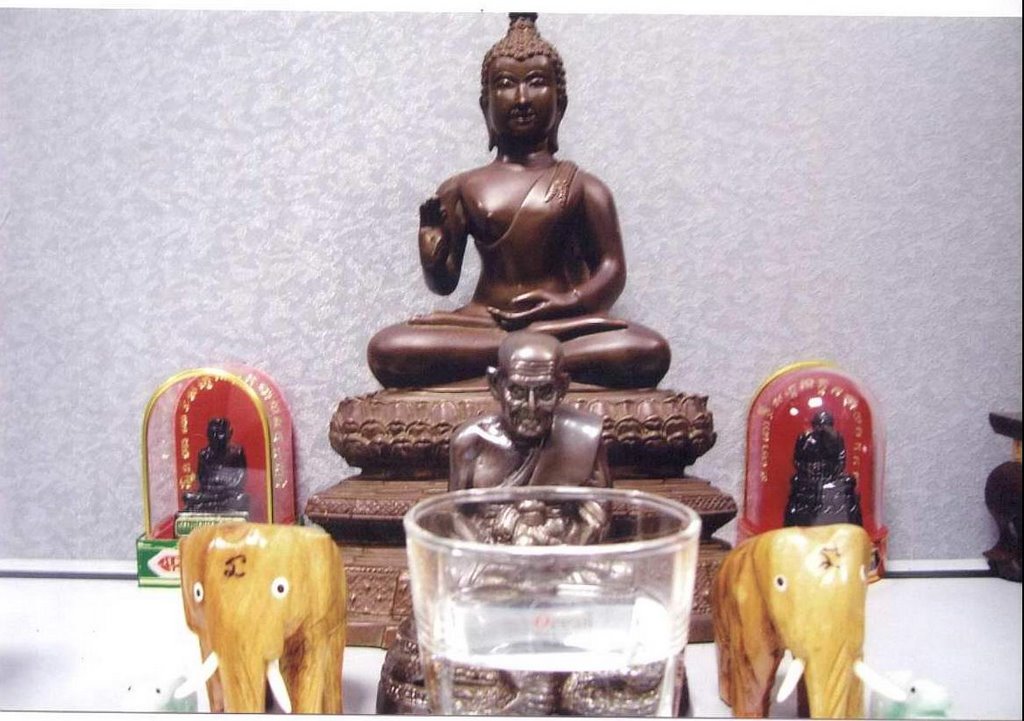
 1) A bronze 5-inch bucha of Shakyamuni Buddha seated in the full lotus position and showing the "Vitarka Mudra" (gesture of discussion or transmission) with his right hand. There's a story on how I found this bucha, but I shall talk about it later.
 2) A bronze 3-inch bucha of LP Tuad in a seated in a half-lotus position & holding an orb. There's also a King Cobra encircling his seat. Sharp eye readers would know this a the signature LP Tuad image from Wat Pako in Songkhla. I got this bucha on my 2nd trip there last year (2006).
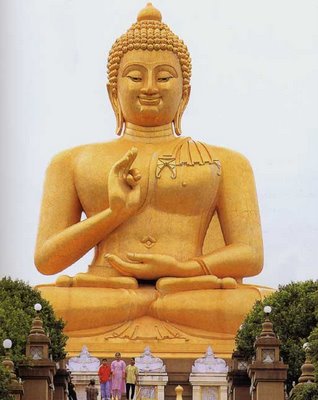 It was only until yesterday (7.1.2007) that I realized where it came from. While surfing a tourism website of South Thailand
 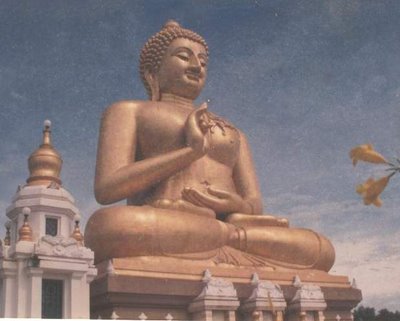 The temple used to be visited by many tourists, but since the terrorist insurgency began in the South a couple of years ago, it has become quite deserted. However, it is precisely due to the atmosphere of fear pervading the whole region that the significance of this Buddha becomes more striking. With all the bombs exploding here & there, & with so many innocent people getting killed; yet the Buddha continues to sit there calmly, transmitting the Dhamma to all beings who still come to take refuge. Do you see the powerful contrast of imagery there? The fact that I came to obtain a bucha of Phra Buddha Taksin reveals the karmic affinity I have with this Buddha.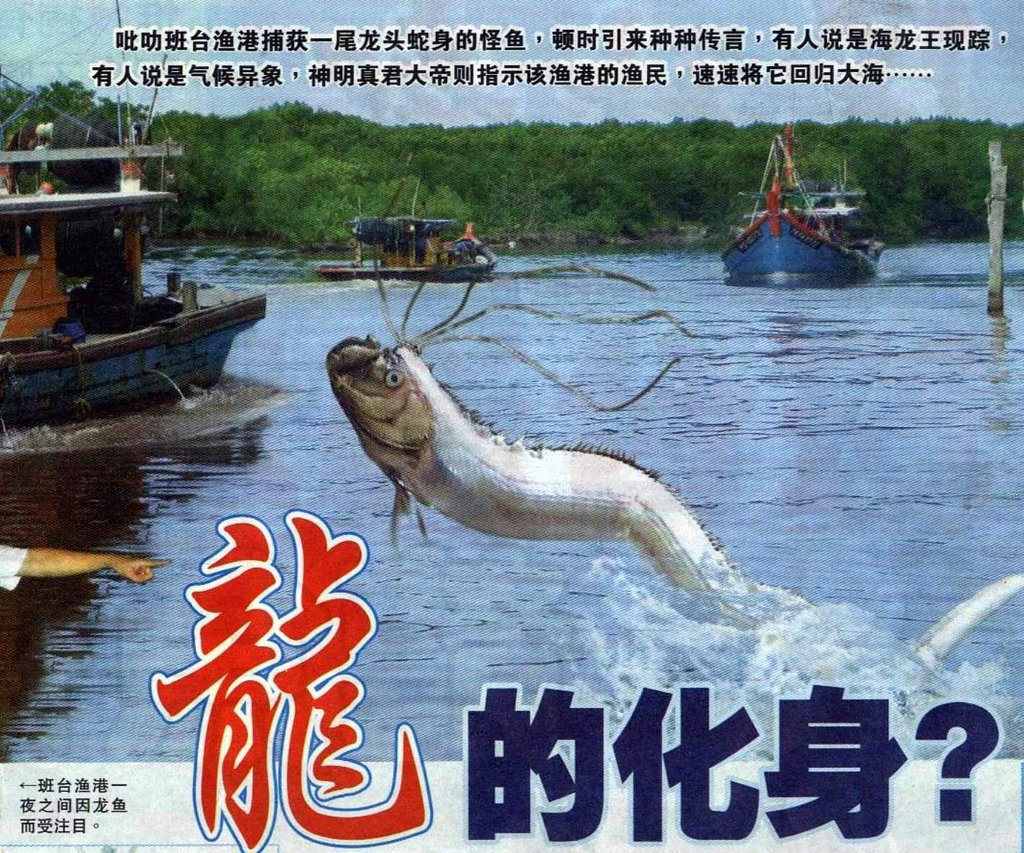
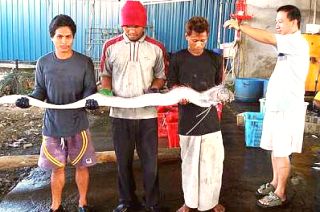 They had originally intended to send its body to a taxidermist for preservation, but called off the idea under advice from a village medium. Instead they were instructed to return the "Naga" carcass to the sea, which they dutifully complied. Pantai Remis assemblyman Nga Kor Ming said that according to local superstition, the fish was one of the "family members" of a Sea Naga King. "If you kidnap the Sea Naga King's children, you are looking for trouble," he said. The fishermen so deeply believed in this theory that they even turned down a RM50,000 offer to part with the dead creature!
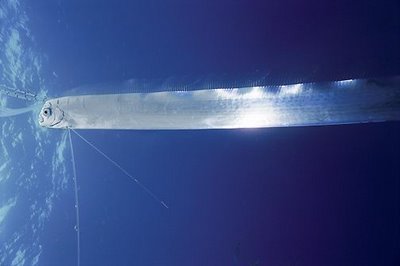 This type of "Naga", which has "dragon whiskers", red dorsal fins and a long, silvery body, is actualy an Oarfish (Regalecus russellii). The rare oarfish is reputed to be the longest of bony fishes in the world. It is not surprising that the fishermen know nothing about it, because oarfish seldom come to the surface of the sea. They only do so when they are sick or dying. Many other legends are woven up surrounding the capture of a Naga-like oarfish. People say that this kind of creature was seen beached before the Tsunami disaster happened 3 yrs ago. Incidentally, this oarfish was also caught before the recent earthquake in Sumatra. So there is definitely some link between seismic movements on the seabed & the sighting of oarfish. Some people also believe that the massive floods in Johor 2 weeks ago was due to the Sea Naga King's anger over the death of one of his children. Using his elemental powers, the Naga King caused a mighty storm in revenge, flooding the entire state of Johor. Could the floods be linked to the oarfish as well? Unlikely, as Johor is too far from Pantai Remis & it would be hard to build any relation between the 2 events.
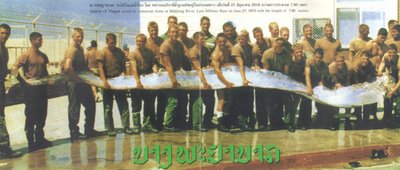 This story also brings to mind this widely circulated photo in Thailand, supposedly of the "Queen of Nagas seized by American Army at Mekhong River, Laos Military Base on Jun 27 1973". The creature seen in the photo is also an oarfish, but it is much bigger than the one caught in Pantai Remis. This oarfish is 7.8m long! There is also a legend surrounding this picture saying that those soldiers shown in the photo had all died as a result of the bad karma caused by killing a Naga. But the myth has been debunked some time ago. This photo was identified by one of the guys in it - 30 yr old Andy Z. According to Andy this was taken on Sep 19 1996 at the Naval Special Warfare Center, Coronado, California. "We were on our morning physical fitness run," Andy recalls, "when we came across this huge fish lying on the sand." At 23 feet in length and 4 feet in circumference, it was quite a shocking sight for the Navy SEAL cadets. Not suprisingly, the photo has been modified in Thailand to make the oarfish more convincing as a real Naga.