Sunday, September 19, 2010

Questions & Answers on the Netherworld II

The following is an interview of Mr Li Shu by his good friend Lin You Xiang. It is called "幽冥问答录" in Chinese. Mr Li had worked as a Judge in the Netherworld in the beginning of the previous century, and wished to share his experiences with his close friends. This interview was written down many decades ago and gives a very detailed, first-hand account of life in the ghost realm.

Q21: In dishing out punishment in the netherworld, are there any situations of passing the wrong judgement?

A: Never. In the netherworld they have clear and detailed records of the misdeeds of every sinner. Because of the hard evidence available, we could always provide a fair and just judgement.


Q22: We have so many thoughts passing through our heads everyday and in one lifetime they can be beyond count. We ourselves can not remember whether those thoughts are good or evil; how then can the officers in the netherworld record with such detail? Won't it be too tedious?

A: For inconsequential thoughts arising and passing away in quick succession, they won't be recorded down. However if one focuses one's mind on something, constantly thinking of it, be it wholesome or unwholesome, then such thoughts will be recorded down by the officers even if they do not translate into real action. If one actually acts upon them, then the merit and demerit recorded will be all the more clear and obvious.


Q23: Will those great cultivators of the Dharma be judged in the netherworld as well?

A: The netherworld court is only in charge of those being weighed down by some serious karma, or ordinary run-of-the-mill people with no significant good or evil karma. For those great cultivators, they are immediately reborn in the Pure Land or the heavenly realms. There's no need for them to go through the netherworld, nor are their names recorded in the books there. If for some reason their rebirth is delayed and they end up in the netherworld, all the officers will also stand up to receive them. Their spirits become larger and larger as they approach the bench, reaching as high as the roof. Once their names are called, they will ascend to the heavens right away and there's no way we can detain them.


Q24: Are there any foreigners in the netherworld? If so how can you communicate with each other? If there are none, then where do they go to be judged after they die?

A: When I was a judge, it was the Geng Zi year and the 8 allied armies conquered Beijing. Many local and foreign soldiers and civilians died in the war. Thus we saw a small no of foreigners in the netherworld court, but somehow we could still understand their languages. I also dealt with a commander named XXX and several loyal people who sacrificed their lives for the country. I saw with my own eyes that they rose up to the heavenly realms without need for any trial. Since there are so many different netherworld courts in the different regions of China, I think it is not unreasonable to assume that the same situation applies to countries in Europe and America.


Q25: Why do the netherworld government regularly invite humans to work there?

A: Because the rich and noble people usually have many guardian deities in their houses, as well as young and healthy servants emitting a strong level of Yang energy. It won't be easy for the ghost soldiers to go near them when they're about to die. The same applies to those military commanders who are about to die in camp, but are surrounded by all sorts of weapons and young soldiers on guard. That's why they need the spirits of the living humans to go through those barriers and arrest the dying person.*

*Live spirits are not affected by Yang energy.

Q26: For those people who died a violent death, with body parts missing or mutilated; are their ghostly forms any different from those who died normally?

A: Well actually their form is complete, no different from other ghosts. However their faces appear a little blur and there are blood stains visible on their injured parts. They also look sorrowful and pitiful, like they are in a lot of pain.

Q27: Is there a time when ghosts die and disappear from that realm also?

A: Yes. The oldest ghosts I saw were from the Song and Yuan dynasties*. But I have never met any ghosts from the Tang dynasty or earlier. Most probably they have exhausted their lifespan and passed away from the ghost realm. Unless they become Immortals or Buddhas, otherwise none can live forever.

*The oldest ghosts were around 800-1,000 yrs old.

Q28: Human appearances change and age as they grow from young to old; is it the same for ghosts?

A: The ghosts' appearances are the same as when they passed away from the human world. They do not seem to age as they grow older.

Q29: Is there day and night in the netherworld, and can we see the sun, moon and stars?

A: There is day and night like the human world, but one can never see the sun, moon and stars there. It is as if one is constantly stuck in the foggy weather in Sichuan province or the sandstorms in Northern China - there's never any clear sunny day in the netherworld. Everyday from 8am to 11am, all the ghosts will be hiding in the cool, dark areas as they are afraid of getting burned by the rising Yang energy in the morning. They will start to go out only after noon time.

Q30: Are there 4 seasons in the netherworld as well?

A: Yes, however it is not as hot in the summer and much colder in the winter as compared to the human world.

Q31: Is there food and drink in the netherworld? The paper money that we burn for the ghosts, can they be used to buy stuff there?

A: Yes. They eat many kinds of vegetables* and they do use the money to buy stuff.

*Vegetables that are thrown away in the human world become food for the ghosts.

Q32: Do ghosts need to eat 3 meals a day?

A: No, every time they eat, they will be full for a few days. So they eat much less regularly than humans.

Q33: Do ghosts need to sleep?

A: Well I do see beds and blankets but I never saw any of them sleeping. They will just walk around and close their eyes to rest for a short while. That is sufficient sleep for them and they don't need to sleep 7-8 hrs like us humans.

Q34: Are there street markets and shops there?

A: Yes but only on a minor scale, much like our small town shops. What is sold there are mostly food, drink and misc day to day items. There are no grand shopping malls like in the human world.

Q35: Can the ghosts and deities consume the food and drink that humans offer to them during religious ceremonies?

A: Yes, but they can only consume the smell of the offerings, not physically eat them. For example during summer if there are 2 identical bowls of food and we offer one bowl to the ghosts and keep the other bowl, the food that has been offered will surely rot first. Why? Because its "energy" has already been consumed by the ghosts.

Q36: Which food is better? Human or netherworld food?

A: Netherworld food can't be compared to human food.

Q37: Are there family relations for the ghosts in the netherworld?

A: Yes, but they might not be the same as what they used to have in the human world. Because they also have marriage and children in the netherworld*.

*That's why there are stories of ghosts who ask their human relatives to marry them through a netherworld marriage ceremony, usually performed by a Taoist priest.

Q38: Do ghosts live around their graves in the human world?

A: They do.

Q39: Is is painful for a person who just died and the spirit is separated from the body?

A: Most people are sick when they are about to die. When they die and their spirits leave their body, it is no different from opening the door and leaving a house. If they think about the suffering experienced due to sickness, they will feel that dying is a form of release. However if they still cling on to their dear ones or their wealth, they will find it hard to die as their spirits refuse to leave their bodies. That is where they experience the worst pain of death. For those who are by nature dispassionate, who feel little clinging to their family or possessions in this world; they will be able to pass away with ease, just like taking off one's clothes.

Q40: For the monks and priests who chant scriptures for the deliverance of the departed, are there any real benefits for the dead?

A: It all depends. For those who have performed great merits or committed heinous sins, they will immediately be reborn in heaven or hell and thus they have either no need or cannot receive the benefits of the chanting. Only those ordinary beings who have neither significant good nor evil karma will actually benefit from it in the netherworld. Then again the level of cultivation for the person chanting also plays an important part. A sutra recited once by a high level monk or filial descendant is 10 times better than one recited by an ordinary monk. An ordinary monk who puts his utmost sincerity and respect into chanting will also be able to generate great benefit for the dead. If an ordinary monk recites without any sincerity at all, then there is hardly any benefit to speak of. It is best to chant sutras for the dead within 49 days of their deaths. Beyond that they might have been sent to be reborn in other realms and the merits won't be able to reach them so easily.

**To be continued..**

Tuesday, September 14, 2010

MM Lee's views on Buddhism

MM Lee commented in an interview on 1/9/2010 that:
>
"The Buddhist believes in transmigration of the soul. If you live a good life, the reward is in your next migration, you will be a good being, not an ugly animal. It is a comforting thought, but my wife and I do not believe in it. She has been for two years bed-ridden, unable to speak after a series of strokes. I am not going to convert her. I am not going to allow anybody to convert her because I know it will be against what she believed in all her life. How do I comfort myself? Well, I say life is just like that. You can’t choose how you go unless you are going to take an overdose of sleeping pills, like sodium amytal. For just over two years, she has been inert in bed, but still cognitive. She understands when I talk to her, which I do every night. She keeps awake for me; I tell her about my day’s work, read her favourite poems.”
>
I think it comes as no surprise that MM Lee's understanding of Buddhism is quite superficial, no different from any ordinary man on the street. Afterall he has been secular and agnostic all his life. Belief in the transmigration, which is just another word for reincarnation of the soul is Hindu or Taoist in origin. Buddhists neither believe in a soul nor something that transmigrate from life to life. It is an eternalistic view that the Buddha rejected along with the nihilistic view of the materialists. What people call "Self" or "Soul" is merely a series of everchanging mental and physical factors that arise and pass away in accordance with cause and effect, nothing more. As such, MM Lee should not subscribe to one of the most common misconceptions that people have about Buddhism.
>
As for being rewarded in one's next life for doing good, that's not correct either. One of the virtues of the Dhamma is "Akaliko", or timelessness. The practice of the Dhamma is something that can be experienced here and now, with immediate results. One need not wait until the next life to receive one's reward. For example, when one practices meditation earnestly, one experiences calmness and serenity of mind right away. This is the reward in itself. MM Lee has experienced this "reward" himself, practicing the tranquility meditation that he learned from Mr Ng Kok Song; yet he does not realize it. Doing good and feeling joy all have an immediate effect on our consciousness and sub-conscious mind. If one develops mindfulness, one will realize this by oneself. As for what benefits one will get in the future, there's no point speculating whether there is or is not because knowledge will come by itself when one gains insight into the ultimate reality. At least MM still have a workable mind to train in calmness. For Mrs Lee, she is already in the final stage of life and no longer able to help herself. She will pass away in that helpless state, and go where her karma compels her to go. We come to this world with nothing and will also leave it with nothing. All that accompanies us are the good and evil deeds that we have done in this life. If there's anything MM should rightly understand about Buddhism, may he understand these 3 points, sadhu.

Monday, September 13, 2010

Questions & Answers on the Netherworld I

The following is an interview of Mr Li Shu by his good friend Lin You Xiang. It is called "幽冥问答录" in Chinese. Mr Li had worked as a Judge in the Netherworld in the beginning of the previous century, and wished to share his experiences with his close friends. This interview was written down many decades ago and gives a very detailed, first-hand account of life in the ghost realm.

Q1: Sir, is it true that you have worked as a Judge in the Netherworld in your younger days?
A: Yes it's true. Most people in this world find this very strange, but to me it was very normal.


Q2: When did this happen?
A: In the Geng Zi year of Emperor Guangxu's reign (1900). At that time I was only 19.


Q3: What was your position, who were you under and how many subordinates did you have?
A: I was under the Lord of Taishan*, but I never had the chance to meet him. All I did was submit my verdict after every judgement. At that time I was a Judge in one of the sub-courts and had 4 jury members to help me. As for the little ghosts handling the menial tasks, there were too many to count.


*The Lord of Taishan was equivalent to a Prime Minister in the ghost realm, in charge of the whole East Asia region. One term lasted 500 yrs, after which he would be replaced by another person. In terms of rank he was the 2nd highest authority, right below King Yama.*


Q4: How long did you work as a Judge? Did you work everyday and what region were you in charge of?
A: For 4-5 yrs. Yes I went everyday, and was in charge of 5 provinces of Northern China.


Q5: Why did "they" invite you to be a judge in the netherworld?
A: I asked my colleagues about this and the reason was because I had worked as a judge before in my previous lives. So as a result of past affinity, there I went again.


Q6: Is there written law in the netherworld? If not how could you judge without making any mistakes?
A: There isn't any. We judged according to the case and could naturally grasp the crux of the matter. There was no need to ponder at all.


Q7: What cases were you in charge of?
A: I judged the good and evil deeds within the first 10 months after a person's death. Beyond that there were others in charge.


Q8: Have you met King Yama?
A: Never did*.


*In the same way that provincial officials in China hardly have a chance to meet the Prime Minister or President, so it was not easy for Li to see King Yama or even the Lord of Taishan.*


Q9: How is it possible for the spirits to see all the good and evil deeds of humans, and record everything down without fail?
A: The spirits could see and hear things that humans could not. Thus all the thoughts and actions of humans are very clear for them to perceive and record down in detail. They could also tell the good and evil thoughts in a person's mind just by looking at the colour of the aura emitting from his or her head.


Q10: Were there sinful ghosts who refused to admit their guilt and tried to argue?
A: Many. Most of them would try their best to argue their case. Only when the solid evidence was brought before them that they had no choice but to bow down and admit their misdeeds.


Q11: After a person died, are they in a dream state or are they in a normal conscious state?
A: Normal conscious state*.


*Li was referring to after a person had been reborn as a ghost. If the person was still in the "in-between" or bardo state, then his consciousness would feel like it is dreaming.*


Q12: What time did you go to the netherworld everyday? What was the working hours like?
A: At first it was in the evening; later I could even go in the day, but it had to be in the afternoon. The journey to and fro took place in a sedan which moved very fast. Usually I judged for a few hours but there were also complicated cases which took a few days to reach a verdict. Thankfully cases like these were rare.


Q13: When you went to the netherworld was your physical body asleep?
A: Yes I was lying on my bed as if in a deep sleep. There was no need to eat or drink and one would not feel hungry or thirsty either. Sometimes when my consciousness was in the ghost realm and relatives came to visit me, I had to talk to them with my eyes closed. I could answer their questions but could not ask any myself. After the dialogue I would have no memory of what we talked about anyway.


Q14: After you come back from the netherworld, did you feel tired?
A: Yes slightly, like when you did not have a good night's sleep.


Q15: Was there food and drink in the netherworld?
A: Yes, but they did not allow me to consume them*.


*Because it was not suitable for human beings*.


Q16: What was the working attire there like? What was the format of the official documents and how were they processed?
A: When I was a judge there, we were still under the Qing government rule. As such the attire, format and processing of the documents were no different from the Qing officials. But after the revolution and birth of the Chinese Republic, I believe the system there had changed accordingly as well*.

*The netherworld is a close reflection of the human world*.

Q17: Did the netherworld judges receive a salary?
A: Yes, but the money is totally useless for humans*, so I did not take it.


*Paper money or Hell bank notes cannot be used to buy anything in the human world, as such they are useless.*

Q18: How many different types of punishment are there in the netherworld?
A: Too many. And they are all hundreds of times more terrible than those in the human world. In the modern context they would be viewed as extremely brutal. But from my personal experience, it is better to take the punishment in the human world as it will end after you die. In the netherworld you have to suffer it again and again! For example, a sinner who murdered 10 people will have to be tortured to death 10 times in hell. Then he would be sent to be reborn 10 times and be murdered by others in every life. Tortures such as the saw mill, the grinder, the mountain of knifes and the wok of boiling oil are all real. The fruits of evil karma are truly frightening indeed!


Q19: What virtues are most valued in the netherworld? And what evil deeds are most detested?
A: For men, the virtues were loyalty to the country and filial piety. For women, it was fidelity and filial piety*. These men and women could have their punishment reduced even if they were guilty of other wrongdoings. For evil deeds, killing and sexual misconduct were most detested. Killing is the heavier of the 2 and if a person killed another due to sexual misconduct, his punishment would be doubled as a result. Thus the ancients say, "10,000 evils originate from lust".

*In accordance to the conservative values in those feudal times.*

Q20: Since there was no written law in the netherworld, how do you judge whether an evil deed was light or heavy?
A: It all depends on the person's motivation in doing the deed and the effect it had on others. We used reasoning to come up with an appropriate sentence for each wrongdoing by considering all the circumstances.

**To be continued..**

Monday, September 06, 2010

LP Kern of Wat Klong Buri


Arriving at Wat Klong Buri in Sakaew to see LP Kern, the master of Khmer Metta magic. He is a disciple of Cambodian master LP Gai.


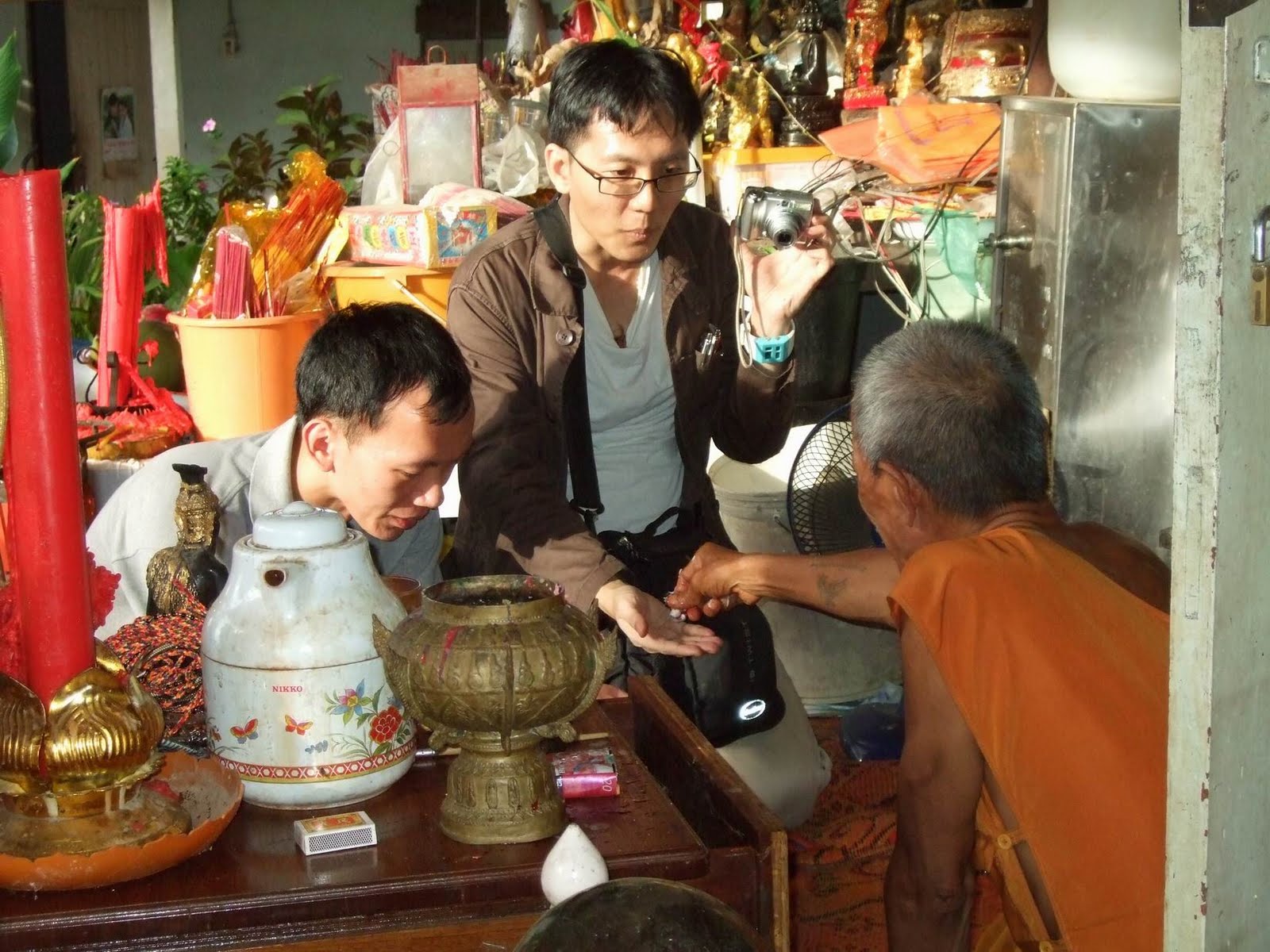
Receiving the Metta blessing ritual from LP Kern. It is done on both the front and the back.
Accepting the holy amulets from LP after he reblessed them.
LP also gave the Metta blessing to my friend.

Sunday, September 05, 2010

LP Nong of Wat Wang Si Thong

LP Nong of Wat Wang Si Thong is a well-known master in Sakaew who have blessed a wide variety of amulets and images in recent times. He is already very old but he will personally rebless the items that you chow from the temple.
The altar in LP Nong's kuti.
One of the monks asking LP Nong to give us some of his hair to keep as relics. He is a bit hard of hearing due to his age.
The 5" Lersi Narai bucha that I chowed.

Saturday, August 28, 2010

LP Kalong's body at Wat Kao Laem


Video of the hall interior where LP Kalong's body is venerated. It was my first visit to Wat Kao Laem in Sakaew province.
Shot of the casket containing LP's body.
Paying homage to LP Kalong.
Temple gate.
Naga staircase.
Far view of the Ubosot.
A golden chedi.
Jatukam shrine.

Friday, August 27, 2010

The biggest Guan Gong statue in the world

Recently, the Shanxi provincial government in China has completed a project to build the biggest Guan Gong statue in the world at the birthplace of General Guan - Chang Ping village near Yuncheng city. This is to commemorate the deity and also to promote tourism. The bronze statue is 61m tall, symbolizing the age when Guan Gong passed away and the platform is 19m tall, symbolizing the age when he left his home town. Over 500 tons of copper, 2,000 tons of steel and 18,000 tons of earth were used to build this statue.

Indeed, of all the guardian deities in Buddhism, only Guan Gong enjoys such high respect and has such a giant statue built in his honor. Again, this is an eternal testament to the traditional values of loyalty, courage, humanity and righteousness, represented by Guan Gong. Even though the Chinese government build large monuments like these to attract the tourist dollar rather than promoting traditional values, they still serve to inspire all people who look upon them in one way or another. The Guan Gong monument park will be officially opened on Sep 13th 2010.

Monday, August 23, 2010

Coffin Sleeping Ritual in Singapore

Today there is an article in both Shinmin and Wanbao about a reportedly possessed young girl, whose family had to spend around $30K to perform an exorcism ritual for her, done by members of the Yin Fu Dian temple in Bt Batok. It was a very elaborate ritual involving the temple mediums and many helpers, who had to set up a golden coffin, various instruments, food offerings, paper money, figurines and bridge at the Choa Chu Kang cemetery. The girl had to walk through a symbolic Hell setting and lay in the coffin for 3 hours while the mediums recite their prayers. We seldom see such elaborate rituals here, which was why it stirred up such strong interest in the Chinese tabloids.

This ritual is similar to those luck changing rituals in Thailand where the person needs to sleep in a coffin and be "reborn" after special prayers by monks are performed to dissolve his or her old karma. The 2008 movie "The Coffin" is a much dramatized horror film using this ritual as its theme. But the important question that we all want to ask is: does it work? Only those people who have tried it will know. If we talk about possession, we don't really need such a complicated ceremony to solve the problem. Simply using holy water will do. If we talk about black magic, we have to see what kind of black magic and this ritual might only work for some forms of it and not others. If we talk about previous bad karma, then practicing Vipassana meditation and experiencing various painful Vedana (feelings) is the best way to expiate them. So we should not blindly put our faith in such rituals, but always try to use wisdom and mindfulness to scrutinize them well first. As the Buddha said, "Dhamma is the best medicine." Because in reality, we are all sleeping in our own coffin. What is this coffin? It is the 5 aggregates of clinging (upadana khanda). Clinging to form, feelings, perception, volition and consciousness binds us forever to the endless cycle of becoming. The 5 desires, desire for wealth, sex, fame, food and sleep are our coffin. We are constantly buried in the sea of suffering due to the pursuit of these desires. The desire for pleasant sights, sounds, smell, taste, touch are also no different. How can we ever rise up from this coffin and be "reborn"? Only through the cutting off, abandoning, renouncing and giving up of all forms of clinging and desires can it be achieved. Only by letting them die then can one be reborn as an Arya, a Noble one who has seen the end of suffering. Perhaps that is the true meaning behind the symbolism of the coffin ritual.

Wednesday, August 18, 2010

Wat Sotorn in Chachengsao


Videos taken at the old and new Ubosots of Wat Sotorn, Chachengsao on Asalha bucha day 2553.
Close up of the original LP Sotorn statue inside the old Ubosot.
LP Sotorn inside the new Ubosot.
A closer shot.
The LP Sotorn Katha:
Namo Tassa (3x)
Iti Iti Iti Sotaro
Na Mo Put Ta Ya
Ya Ta Put Mo Na.
Back of the statue.
Phra Sangkachai 5" bucha chowed at the old Ubosot.

Saturday, August 14, 2010

Bogus Taiwan Master cons girls with Thai amulets

Couple of days ago there was an article in the Shinmin paper about a high profile religious conman in Taiwan being arrested for his crimes. Zheng Guanqian, has for some years gone around Taipei pretending to be an expert in Maoshan Taoist magic as well as the "only Thai black magic master" in Taiwan. Zheng has appeared on various news programs, paranormal variety shows, magazines and even writes his own books. As a result there were many gullible people who became his followers. He also has a blog about his so-called magical arts as well as an account on Yahoo auction selling Thai amulets. Having set up an altar in his hometown Tucheng, he provided religious services for women suffering from marriage and relationship problems, collecting amounts from 2,000 - 200,000 NTD from them for his rituals and amulets. Zheng sold mainly non-mainstream stuff like animal and human lukkok (seen above) which promised fast results, in line with his crooked personality. Zheng with variety show host Xiao Pan Pan. As we can see he wears a chain of 7 amulets. He started to run afoul of the law when he tricked several of the more attractive girls who came to look for him to perform oral sex for him, with the excuse of making "Metta Oil" for them. Zheng told them that the 2 most important ingredients for the oil was "their saliva and his semen", so naturally oral sex was the only way to acquire them. He promised that this Metta oil will solve whatever problems they had. This went on for a while and eventually some of these girls woke up and reported him to the police. The rest is history. When arrested, some of the cops asked him, "Will those little ghosts (that Zheng rears) help you in court and prison?" Zheng's dejected reply was, "They ran away long ago". Pic of Zheng visiting LP Up of Wat Thongsai, Nakhon Pathom, probably for getting his Mae Nang Pim amulets. The reason that Zheng was able to succeed in his sexual crimes was partially due to a general ignorance about Thai Buddhism and amulets in Taiwan and also Hong Kong. From time to time we hear similar stories of religious conmen tricking girls into having sex with them in the pretext of performing some magic ritual for them to solve their problems. These conmen almost certainly claim either to be Thai, Taoist or Tibetan magic experts, or even all of the above. That is not to say that such crimes don't happen in Singapore and Malaysia, but the people here are relatively more knowledgeable about such things due to our proximity to Thailand. Furthermore there are many different reputable guru monks and Ajarns from Thailand who visit Singapore and Malaysia regularly to meet devotees here. This greatly reduce the chance of bogus masters succeeding in conning a large number of people. As the Chinese saying goes, "When there are no tigers on the mountain, the monkeys declare themselves king". Such is the case in Taiwan and Hong Kong. However if we really want to look for the true cause of such religious crimes, it is that desire to get a quick fix to our problems that turns many people into fools. They fall easy prey to conmen offering magical solutions, ending up losing lots of money or being used and abused if they are attractive females. As such, the wise Luang Pors always teach us not to rely too much on Wicha, but to chant the holy verses and practice Vipassana meditation. Hard to accept as it might be, this is the only real and reliable way to solve our problems.

Tuesday, August 10, 2010

LP Foo of Wat Bangsamak


Short clips of our visit to Wat Bangsamak, Chachengsao on Asalha bucha day 2553. This is the temple of the famous LP Foo.
Consecrations photos of the latest batch of amulets.
LP Foo's secretary reblessing the amulets we chowed from the temple.
Billboard advertising the batch of amulets consecrated last year.
Phra Sivali Shrine.
Vihara to LP Foo's parents.
The large Chedi of the temple.
Portrait of LP Foo. He was not around when we visited. Though he is famous in central Thailand and Bangkok, he is still relatively unknown in Singapore.

Thursday, August 05, 2010

Wat Lin Thong in Ang Thong


Wat Lin Thong is a famous temple in Ang Thong province which specializes in Lersi Wicha. Above are short clips of the surroundings at the temple.
The open field at the temple is surrounded by statues of the various Lersis.
Having a shot taken with one of the great Lersi.
Portrait of LP Sakchai, young abbot of Wat Lin Thong. He is an up and coming master. However he was not around when we visited the temple.

Monday, August 02, 2010

The Blood Consecration of LP Samchai

Recently we visited a up and coming Wicha master, LP Samchai of Wat Dongradee, Ang Thong to chow his amulets and Lersi buchas. His temple was not really a temple, but a small shrine and kuti in a rice field. So LP was in need of funds to build up his temple. On conversing with him, I learned that he was of Chinese Teochew descent and could speak the dialect. He told me in Teochew some story of a Bangkok guy wearing his takrut escaping from a gang attack unhurt. So after chowing the amulets and the Phra Lersi Prom bucha (above left), I asked LP to rebless the bucha for me. Never did we expect him to show us his power by using his own blood to do the consecration!

An extract video of the blood consecration.
The rest of the consecration pics. At the end of the ceremony, LP gave each of us free tiger rians, but our driver was too shocked to take his.. so I ended up with 2 rians on top of what I already chowed. I've seen a lot in Thai Buddhism, but it was also the first time for me witnessing this kind of ceremony up close. I was filled with a mixture of shock as well as awe for this master.
The blood and wax stained Phra Lersi Prom 5" bucha.